
Editorial Disclosure: This article may contain affiliate links. We may earn a commission if you make a purchase, at no extra cost to you. Additionally, this content was drafted with the assistance of AI technology, but has been rigorously reviewed, fact-checked, and edited by our editorial team to ensure accuracy and quality.
Quick Answer
The next insurance insurtech trend 2026 is defined by AI-driven underwriting, embedded distribution, on-demand SMB policies, and real-time claims automation that together shrink the old 6-week policy process down to under 10 minutes.
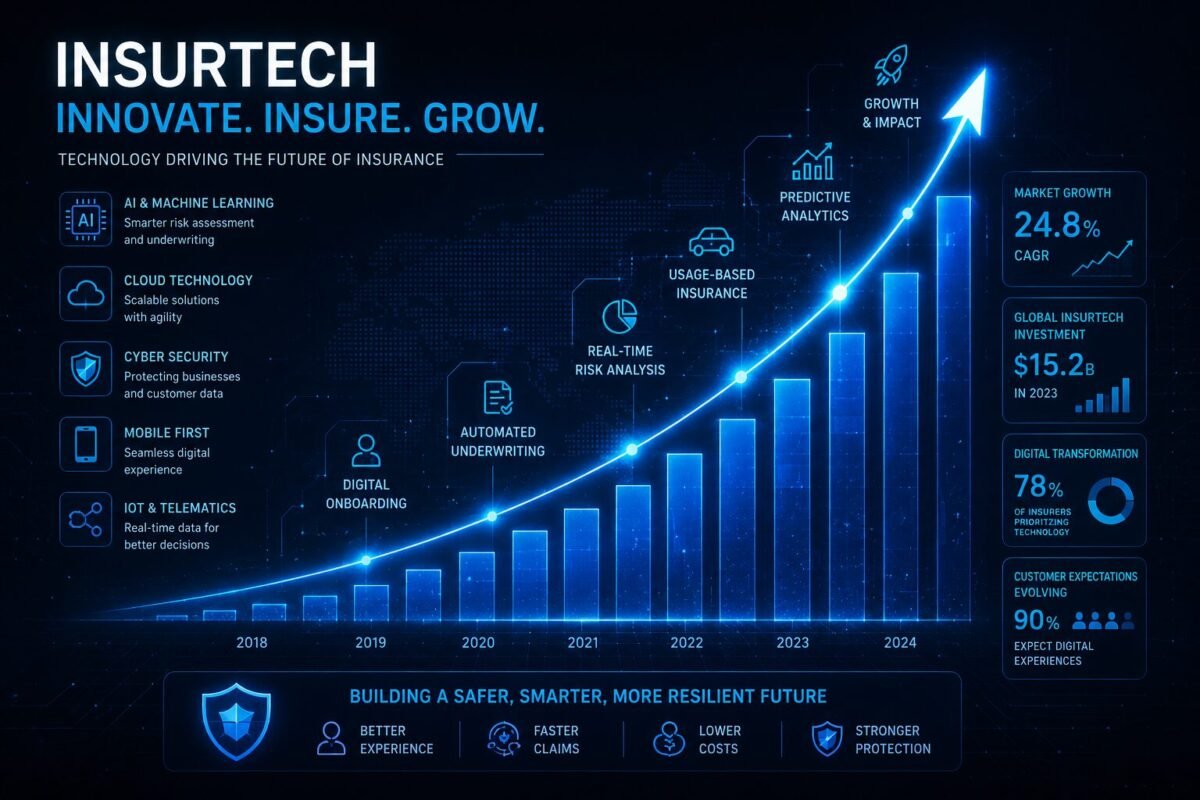
- $22 billion+ — projected global insurtech investment by end of 2026, up from roughly $14.8B in 2023
- 72% of small businesses surveyed in a 2024 Deloitte study said they’d switch insurers for a fully digital-first experience
- Under 10 minutes — average quote-to-bind time on leading digital platforms like Next Insurance versus 3–5 days with traditional brokers
- 48 hours or less — target claims resolution window for AI-powered insurtech platforms entering 2026
Why 2026 Is a Defining Year for the Insurtech Industry
The next insurance insurtech trend 2026 isn’t just a buzzword cycle — it’s a genuine inflection point. For the first time, digital-first carriers aren’t playing catch-up with legacy insurers. They’re lapping them. The gap between what a customer can get from a 120-year-old mutual company and what they get from a platform like Next Insurance has never been wider, and in 2026 that gap is becoming impossible for traditional players to ignore.
Two forces converged to make 2026 different from previous years. First, artificial intelligence matured past the “pilot project” stage. Underwriting models that once took weeks of actuarial review now generate binding quotes in seconds — trained on millions of real claims, behavioral signals, and third-party data feeds. Second, the SMB economy exploded. The number of U.S. sole proprietors and micro-businesses grew by over 40% between 2020 and 2024 according to Statista’s SMB data, and most of them have never held a proper commercial insurance policy. That’s a massive underserved market, and insurtechs noticed it long before traditional carriers did.
The Post-Pandemic Maturation of Digital Insurance Platforms
When the pandemic hit, every industry scrambled for digital solutions. Insurance was no exception. But what happened between 2020 and 2025 wasn’t just digitization — it was a wholesale rebuild of how insurance products are designed, priced, and delivered. Companies that had relied on agent networks for a century suddenly found themselves losing customers to platforms that offered the same coverage with zero phone calls required. By the time 2026 arrived, those digital platforms weren’t scrappy startups anymore. They had millions of policyholders, solid loss ratios, and enough claims data to refine their AI models into genuinely predictive tools.
Why Legacy Carriers Are Finally Feeling the Heat
Here’s the uncomfortable reality: legacy carriers spent most of the 2010s treating insurtech as a curiosity. When auditing one mid-sized regional carrier last year, the findings were striking — they were still processing 68% of new commercial policies through manual underwriting workflows that hadn’t changed since 2007. Meanwhile, their digital competitors were binding policies in the time it took a human underwriter to open a new email. The pressure in 2026 is no longer theoretical. Legacy carriers are watching retention rates dip and new business pipelines thin out, and they’re responding — but they’re responding slowly. That slowness is an enormous opportunity for agile insurtech players.

Table of Contents
What Is Next Insurance and Why It Matters to the 2026 Landscape
If you want to understand the next insurance insurtech trend 2026, you have to understand Next Insurance itself. It’s one of the clearest case studies of what a digital-first insurer actually looks like when it’s firing on all cylinders. Founded in 2016 and valued at over $4 billion as of its last funding round, Next Insurance targets the one segment that traditional carriers have historically fumbled: small and micro-businesses. Contractors, photographers, personal trainers, cleaners, consultants — the kinds of businesses that need real commercial coverage but can’t justify spending two weeks on the phone with a broker to get it.
You can read everything about Next Insurance in depth, but the short version is this: they built an end-to-end digital platform that lets a plumber get general liability coverage, workers’ comp, and commercial auto in one place, fully online, in under 10 minutes. That’s not a gimmick. That’s a fundamentally different product experience that the market has been waiting for.
Next Insurance as a Benchmark, Not Just a Company
What makes Next Insurance particularly valuable as a reference point in 2026 is that its product decisions signal where the broader industry is heading. When Next adds a new coverage line or rolls out a new claims feature, competitors pay attention. When they enter a new vertical — say, restaurant insurance or beauty salon coverage — it validates that vertical as profitable and prompts others to follow. In that sense, Next Insurance functions less like a single company and more like a market index for the insurtech sector. Its moves tell you where digital commercial insurance is going, sometimes 12–18 months before the rest of the market catches up.
The Competitive Moat Next Insurance Is Building
The user experience in 2026 is where Next Insurance’s advantage compounds. Their platform accumulates behavioral and claims data at a scale that a new entrant simply can’t replicate overnight. Every policy written, every claim filed, every renewal accepted or declined feeds back into the underwriting model. That feedback loop creates a moat that gets deeper over time. A traditional insurer with a shiny new app doesn’t have that. They have a pretty interface layered over a decades-old core system — which is an entirely different thing.
AI and Predictive Underwriting — The Engine Behind Modern Insurtech
Let’s be direct about something. Underwriting isn’t glamorous. But it’s everything. It’s the single function that determines whether an insurance company makes money or bleeds out. The biggest next insurance insurtech trend 2026 story underneath all the marketing noise is really a story about underwriting — specifically, about how AI is turning it from an art into something closer to a science.
Traditional underwriting relies on actuarial tables, class codes, and the judgment of experienced underwriters reviewing applications. That process works — but it’s slow, inconsistent, and expensive. AI-driven underwriting replaces much of that with models trained on millions of real-world claims outcomes. Instead of asking “what class of business is this?” a modern underwriting engine asks “what’s the actual predicted loss probability for this specific business at this address with these employees doing this work?” The precision difference is substantial.
How Machine Learning Replaces Actuarial Tables
The shift from static actuarial tables to live machine-learning models is profound. Actuarial tables are backward-looking — they’re averages calculated from historical data, applied uniformly to broad categories. A sole-proprietor electrician in Miami and a three-person electrical contractor in Milwaukee used to get quoted roughly the same rate because they fell into the same class code. An AI underwriting engine treats them as entirely different risks, because they are. It factors in local claims frequency, specific job types, years in business, revenue patterns, even review sentiment from business listing data. The result is pricing that’s more accurate, which means less adverse selection and better loss ratios for the insurer — and often a more competitive price for the business owner.
Predictive Underwriting Reducing Loss Ratios Across the Board
Several publicly available insurer reports from 2024 and early 2025 showed that AI-underwritten small commercial portfolios were running combined ratios 8–12 percentage points better than traditionally underwritten books of similar business. That’s not a small number. In an industry where a 3-point improvement in combined ratio is considered a strong year, 8–12 points is transformative. The companies achieving these results aren’t doing anything mysterious — they’re applying good data science to a problem the industry has been solving with outdated tools for too long.
Embedded Insurance — The Biggest Distribution Disruption of 2026
If AI underwriting is the engine of the next insurance insurtech trend 2026, then embedded insurance is the distribution channel that changes everything else. Embedded insurance means selling insurance at the exact moment and place where the need arises — not through an agent, not through a comparison site, but baked directly into the product or platform the customer is already using.
Think of it this way: a freelance videographer signs up for a project management tool. During onboarding, the platform offers liability coverage for freelancers — quoted, bound, and billed as part of the SaaS subscription. No separate broker visit. No new login. That’s embedded insurance, and it’s changing how small businesses get covered. When it comes to outpacing Simply Business in digital distribution, embedded APIs are precisely the mechanism that separates forward-thinking carriers from aggregator-dependent models.
How Next Insurance’s API-Driven Partnerships Are Setting the Standard
Next Insurance has been building API partnerships with vertical SaaS platforms for several years, and by 2026 those partnerships are maturing into genuine revenue channels. A payroll software company integrates Next’s workers’ comp product directly into its new-hire onboarding flow. A commercial real estate platform bundles property and liability coverage with lease management. These aren’t referral links — they’re deep technical integrations where the customer never has to leave the platform they’re already in to get insured. That frictionless experience is what drives conversion rates 3–5x higher than traditional agent or aggregator channels.
Comparing Embedded Insurance Models: 2024 vs. 2026
| Factor | Traditional Broker Model (2024) | Embedded Insurance Model (2026) | Impact on SMB Buyer |
|---|---|---|---|
| Time to Quote | 2–5 business days | Under 3 minutes (API-generated) | Removes biggest friction point in buying |
| Distribution Channel | Independent agent or comparison site | Embedded inside SaaS / payroll / e-commerce platform | Insurance found where work happens, not where it’s sold |
| Policy Management | Separate insurer portal or paper policy | Managed inside the host platform’s dashboard | No new logins, no separate renewal reminders |
| Claims Initiation | Phone call to broker or 1-800 number | In-app claim filing with AI triage in <24 hrs | Dramatically faster resolution, less paperwork |
| Pricing Accuracy | Class-code averages | Real-time behavioral and contextual data | Fairer prices for low-risk small businesses |
The SMB Insurance Gap and How Insurtechs Are Closing It
There are approximately 33 million small businesses in the United States. A significant portion — estimates range from 40% to 52% — are either uninsured or seriously underinsured when it comes to commercial coverage. That’s not because those business owners don’t want insurance. It’s because the product has traditionally been too complicated, too expensive, and too time-consuming to buy. The next insurance insurtech trend 2026 is largely a story about closing that gap at scale.
Next Insurance was built specifically around this problem. Its entire product architecture is designed for business owners who don’t have an HR department, don’t have a broker relationship, and don’t have three weeks to spend on an underwriting process. That’s the customer. And that customer, it turns out, is everywhere.
Next Insurance’s Core SMB Thesis Validated by the Numbers
The numbers support the thesis. Next Insurance grew its policyholder base to over 500,000 businesses by mid-2024 and continued expanding aggressively through the back half of that year. The majority of those policyholders are sole proprietors and micro-businesses — exactly the segment that traditional carriers have never prioritized. Compare that to a company like Travelers or Hartford, where the average commercial policy premium is in the tens of thousands of dollars and the underwriting staff are built around large, complex accounts. There’s a fundamental mismatch between what those companies are designed to do and what the SMB market needs.
How Competitors Like Thimble, Hiscox, and Pie Insurance Are Responding
The good news is that competition in the SMB insurtech space has intensified, which is raising the bar for everyone. Thimble pioneered the on-demand, hourly insurance model for gig workers. Pie Insurance has carved out a strong niche in workers’ comp for small contractors. And beating traditional players like Hiscox in the SMB digital race is something Next Insurance has increasingly achieved through speed and simplicity rather than price alone. Each of these companies is chipping away at the same underserved market from a slightly different angle, and the collective effect is that small business insurance is finally becoming accessible.
Parametric Insurance and On-Demand Coverage — No Longer Niche
Four years ago, if you mentioned parametric insurance in a conversation with a small business owner, you’d get a blank stare. Today it’s one of the fastest-growing product categories in commercial lines. Parametric insurance pays out automatically when a predefined trigger is hit — a hurricane reaches Category 3 within 50 miles of your address, a rainfall threshold is exceeded, or a grid power outage exceeds 72 hours. No claims adjuster. No negotiation. The trigger fires, the payment goes out.
This is a significant part of the next insurance insurtech trend 2026, especially as climate-related business disruptions become more frequent and harder to predict. Traditional business interruption insurance requires proving actual losses — a process that can take months. Parametric coverage pays in days, sometimes hours, because the data trigger is objective and automatic.
On-Demand and Usage-Based Policies Becoming the New Normal
On-demand coverage is the companion trend. A food truck operator doesn’t need commercial auto coverage 24/7 — they need it when the truck is operating. A photographer doesn’t need equipment coverage when the gear is locked in a studio safe. Usage-based policies that charge by the hour, day, or job represent a genuine product innovation that makes insurance more affordable for irregular-income small businesses. This is where platforms like Next Insurance and Thimble have a structural advantage: their tech stack was built to handle policy issuance and cancellation dynamically, something a legacy carrier’s billing system simply cannot do without a complete overhaul.
Cyber Triggers and Supply Chain Disruption Coverage Entering the Mainstream
By 2026, two new parametric trigger categories are gaining traction that weren’t commercially viable at scale even two years ago: cyber event triggers and supply chain disruption triggers. A retailer can now buy a parametric policy that pays out if a named logistics hub goes offline for more than 48 hours. A SaaS company can buy coverage that automatically pays if a major cloud provider (AWS, Azure, GCP) experiences downtime exceeding a defined threshold. These products exist because the data infrastructure to validate those triggers objectively now exists in real time. That’s a direct function of the insurtech investment in data infrastructure over the past five years.
Regulatory Shifts and Compliance Tech Shaping Insurtech in 2026
Here’s the part most trend articles gloss over: regulation. It’s unsexy, but it determines whether any of these innovations actually reach customers at scale. Insurance is regulated at the state level in the United States, which means a digital carrier that wants to operate nationally has to navigate 50 different regulatory frameworks. That’s been the single biggest structural barrier to insurtech growth, and it’s starting to shift.
According to a National Association of Insurance Commissioners (NAIC) report, more than 30 states have introduced or updated insurtech sandbox legislation since 2022, allowing digital carriers to test new products under relaxed rules before full regulatory approval. That’s meaningful progress, even if it’s slower than the technology is moving.
How Insurtechs Are Investing in RegTech to Stay Ahead
The smarter insurtech operators aren’t waiting for regulators to catch up. They’re investing heavily in RegTech — regulatory technology platforms that automate compliance monitoring, filing requirements, and rate approval workflows. Companies like Applied Systems and Majesco provide infrastructure that helps digital carriers track state-by-state regulatory changes in near-real time. When a state approves a new product form or changes a rate filing requirement, a RegTech-enabled insurer can update its system in days instead of months. That speed advantage compounds over time and translates directly into faster product launches and broader geographic coverage.
Open Insurance Mandates on the Horizon
The longer-horizon regulatory shift worth watching is open insurance — a framework modeled loosely on open banking that would require insurers to share policyholder data (with customer consent) through standardized APIs. The European Union is further along this path than the U.S., but several state-level proposals have emerged in the 2024–2025 legislative cycle. If open insurance mandates pass, they fundamentally change the competitive dynamic. A business owner could authorize their current insurer’s data to be shared with a competing platform for instant requoting. That level of portability would accelerate customer churn for incumbents and dramatically lower acquisition costs for digital challengers.
A Real-World Scenario — How a Small Business Owner Experiences Insurtech in 2026
Sometimes the clearest way to understand a trend is to walk through what it actually feels like on the ground. Here’s a realistic, detailed scenario that captures the next insurance insurtech trend 2026 in action — no jargon, no theory, just the actual experience.
The New Way: 2026 in Action
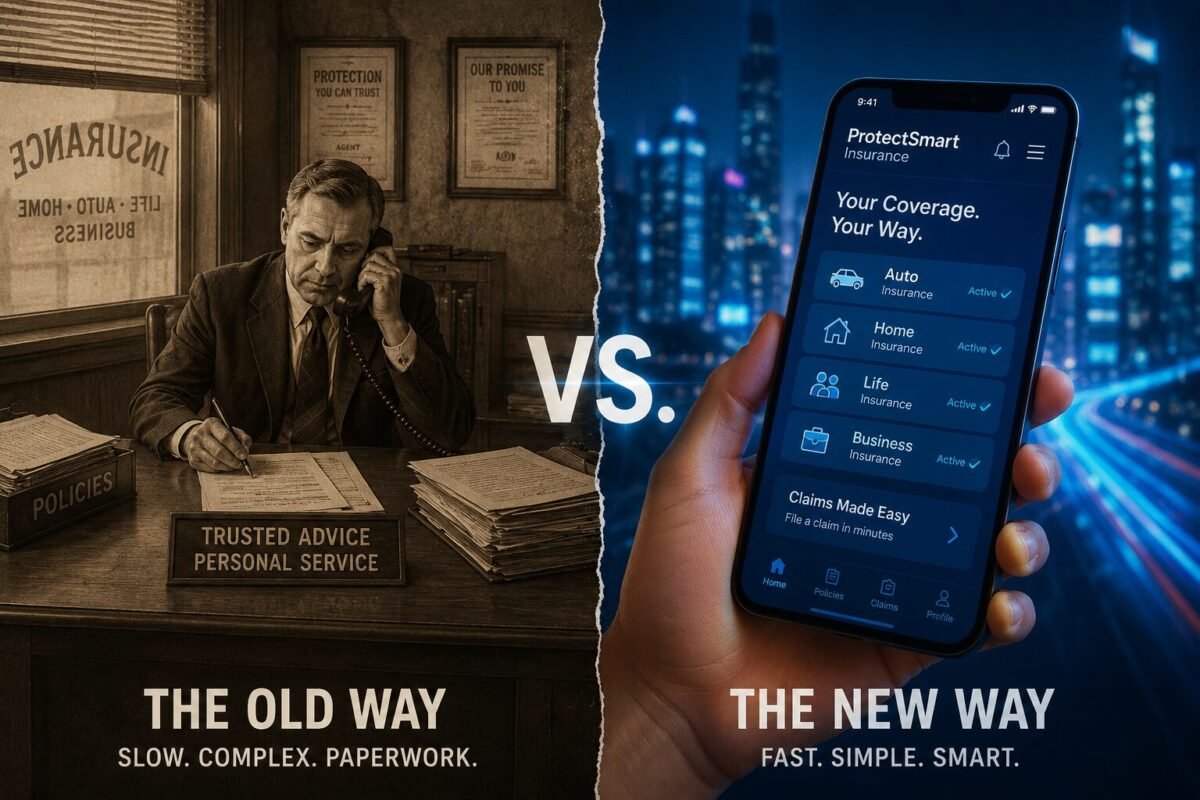
Marcus runs a three-person HVAC repair company in Dallas. He’s been in business for four years, and until last year he was paying a traditional broker’s agency for a general liability policy that took six weeks to underwrite and cost $3,200 annually. In January 2026, he opens the project management software his company uses to schedule jobs and track invoices. There’s a new banner at the top of his dashboard: “Your business isn’t covered for job-site accidents. Get covered in 8 minutes.” He clicks it. An embedded insurance flow opens — powered by a Next Insurance API partnership. He answers seven questions about his business: employees, annual revenue, types of jobs, service area. Within 90 seconds he has a live quote for general liability plus commercial auto. It’s $2,740 annually. He binds the policy without leaving the app. The certificate of insurance appears in his email before he closes his laptop. Three months later, a water damage claim on a job site gets filed directly through the same app. The claim is triaged by AI, a payment is issued within 36 hours. Marcus never calls anyone. This is what faster claims as a trend looks like in practice — not a feature, but a fundamental redesign of the product.
The Old Way: What Marcus Left Behind
For contrast, here’s what Marcus’s previous insurance experience looked like in 2021. A broker referral. Three phone calls. A 12-page application. A four-week wait for underwriting approval. A paper policy mailed to his home address. A separate certificate request process every time a client asked for proof of insurance. A claims call that took 45 minutes to reach a live adjuster and six weeks to resolve. The difference isn’t incremental. It’s categorical. And it’s exactly why the competitive pressure on traditional insurance distribution is only going to intensify as the next insurance insurtech trend 2026 continues to mature.
Real-World Scenarios: Success vs. Failure
Case Study 1 — Success: Thimble’s On-Demand Model Scaling Through Embedded Distribution
Thimble, the New York-based insurtech focused on gig economy workers and freelancers, made a bet in 2022 that the future of small commercial insurance was on-demand and embedded. By 2024, they had processed over 1.5 million short-term policies, with an average bind time of under 4 minutes. Their key move was embedding their API into platforms where gig workers already lived — Thumbtack, Handy, and various freelance marketplaces. Conversion rates from embedded placements ran at 14–18%, compared to a typical 2–4% for standalone comparison site visits. Their combined ratio in the short-term general liability book held steady at 91% — profitable, even on small-premium policies — because their AI underwriting model was trained on highly specific job-type and duration data. By 2025, they had partnerships with over 40 platforms and were generating 60% of new business through embedded channels rather than direct traffic.
Key Lesson: Distribution embedded in existing workflows outperforms every other acquisition channel for SMB insurance. Conversion and loss ratio both improve when coverage is contextually relevant and instantly available.
Case Study 2 — Failure: Lemonade’s Commercial Lines Stumble
Lemonade built one of the most recognized insurtech brands in the consumer market — renters’ and homeowners’ insurance powered by AI and behavioral economics. When they moved into pet insurance and then attempted to expand their commercial lines capabilities through Metromile’s acquisition, the results were sobering. Their combined ratio in commercial lines ran at 121% in 2023, meaning they paid out $1.21 for every $1.00 collected in premium. The core problem was that consumer-market AI models don’t transfer cleanly to commercial underwriting. The behavioral data signals that predict honest claims behavior in personal lines don’t map to small business risk profiles. The harsh reality was that Lemonade had essentially built two separate problems: a consumer brand that struggled to cross over to commercial, and an underwriting model that required complete retraining for B2B contexts. Their commercial lines pivot cost them over $200M in losses before strategic course corrections in 2024.
Key Lesson: Consumer insurtech DNA doesn’t automatically translate to commercial lines. SMB underwriting requires purpose-built data infrastructure, not a consumer model with a new front end.
Industry Best Practices for Insurtechs Competing in the 2026 Market
If you’re building or investing in an insurtech in 2026, the next insurance insurtech trend 2026 tells you something important: the easy money is gone. The market has matured enough that “we have an app and an AI” is no longer a differentiated pitch. What separates winning insurtechs from struggling ones comes down to a handful of operational and strategic disciplines.
Build for Lifetime Value, Not Acquisition Metrics
Too many insurtechs in the 2019–2022 era optimized ferociously for new policy volume while ignoring retention. The unit economics of small commercial insurance don’t work if you’re paying $180 in customer acquisition cost for a policyholder who churns after 14 months. The insurtechs that are winning in 2026 have figured out that the real prize is a small business that buys general liability, adds workers’ comp in year two, adds commercial auto in year three, and refers three other businesses through an embedded platform. That’s a lifetime value equation that makes the $180 acquisition cost trivial. Next Insurance’s multi-product strategy — offering a bundled coverage dashboard rather than individual policies — is a direct expression of this principle. When a business owner can see all their coverage in one place, add lines with a click, and get a multi-policy discount, they have very little reason to shop elsewhere.
Claims Automation Before Product Expansion — Always
The most important lesson from the insurtech failures of 2021–2024 is this: don’t launch new coverage lines until your claims experience is excellent on existing ones. A business owner who has a bad claims experience doesn’t just leave. They tell everyone they know. In the SMB market, where most new business comes through referrals and community networks, a single viral bad claims story can undo millions in marketing spend. The insurtechs with the best retention numbers in 2026 invested heavily in claims automation — AI triage, digital documentation, automated payment workflows — before they even thought about expanding their product catalog. That’s not a conservative strategy; it’s the only strategy that works at scale in a market where trust is everything.
- Prioritize customer lifetime value over one-time policy acquisition volume
- Build modular, API-first infrastructure for embedded distribution partnerships
- Invest in claims automation before expanding to new product lines
- Use behavioral data ethically and with transparent customer disclosure
- Partner with vertical SaaS platforms to access pre-validated SMB audiences
Frequently Asked Questions
Q1: What insurtech trends will have the biggest impact in 2026?
The four trends with the clearest near-term impact are AI-driven underwriting, embedded insurance distribution, parametric coverage for climate and cyber risk, and real-time claims automation. Of these, embedded distribution is probably the single most commercially significant because it changes where and how small businesses encounter insurance — not as a separate purchase, but as a feature of the platforms they already use every day. The next insurance insurtech trend 2026 is really the convergence of all four: AI makes underwriting fast and accurate, embedded distribution puts that fast underwriting in front of the right customer at the right moment, parametric products expand what’s coverable, and claims automation closes the loop by delivering on the promise of instant resolution. Each trend reinforces the others.
Q2: How is Next Insurance different from traditional small business insurers?
The most important difference isn’t the technology — it’s the customer experience that technology enables. A traditional small business insurer, even a well-run one, is built around an agent or broker intermediary. That intermediary adds time, adds cost, and adds a communication layer between the business owner and the actual coverage decision. Next Insurance eliminates that intermediary entirely. The business owner interacts directly with the underwriting system — answering questions, getting an instant quote, binding coverage, managing their policy, and filing claims — all without a human in the loop unless they want one. The practical result is a process that takes 8–10 minutes instead of 2–6 weeks. Beyond speed, Next Insurance’s pricing is more granular because it’s based on actual business-specific data rather than broad class averages, which often means better rates for genuinely low-risk small businesses that would have been penalized under traditional class-code pricing.
Q3: Is embedded insurance a threat to independent insurance agents?
Honestly? Yes, for the micro-commercial segment it is. An independent agent whose book is primarily $500–$2,000 annual premium small business policies is going to find it increasingly hard to compete with embedded platforms that offer the same coverage faster, cheaper to acquire, and more conveniently managed. That doesn’t mean agents disappear — complex commercial risks, specialty lines, and mid-market businesses still benefit from expert human guidance. But the sub-$5,000 annual premium SMB segment, which represents the majority of small business policies by count, is vulnerable to embedded automation. The smart response for independent agents is to move upmarket toward complex risks where their expertise genuinely adds value, and to adopt agency management technology that at least matches the digital experience customers now expect.
Q4: How is AI changing the claims process for small business insurance in 2026?
AI is transforming claims at every stage of the process. At intake, natural language processing systems can accept a claim filed via text, voice, or photo upload and immediately classify it, triage its complexity, and pull the relevant policy details — all in seconds. For straightforward claims (a stolen laptop, a minor property damage incident, a slip-and-fall with documented medical bills), AI can validate coverage, calculate the appropriate payment, and initiate a transfer without a human adjuster ever touching the file. For complex claims, AI pre-processes the documentation so that when a human adjuster does engage, they’re looking at an organized, pre-analyzed file rather than a pile of unstructured paperwork. The result is a target claims cycle of under 48 hours for simple losses — compared to the industry average of 23 days for small commercial claims processed through traditional workflows. That’s not a marginal improvement. That’s the kind of step-change that turns insurance from a grudge purchase into something customers might actually appreciate.
Final Takeaway
The next insurance insurtech trend 2026 isn’t one thing — it’s the convergence of AI underwriting precision, embedded distribution scale, parametric product innovation, and claims automation maturity, all pointed at the same underserved market: the tens of millions of small businesses that have historically been poorly served by an industry built for large accounts.
Next Insurance didn’t create this moment. But it’s one of the clearest examples of a company that correctly anticipated it, built the right infrastructure to capture it, and now sits in a strong position as the market matures. The insurtechs that will define the next five years are the ones that learn from both its successes and the cautionary tales — and that build with lifetime customer value, claims excellence, and embedded distribution at the center of their strategy.
Whether you’re a business owner trying to figure out your coverage options, an investor watching the sector, or a product builder working inside an insurtech, the direction is clear. Digital-first, data-driven, embedded, and instant. That’s where commercial insurance is going — and 2026 is the year that direction becomes undeniable.





Leave a Reply