
Editorial Disclosure: This article may contain affiliate links. We may earn a commission if you make a purchase, at no extra cost to you. Additionally, this content was drafted with the assistance of AI technology, but has been rigorously reviewed, fact-checked, and edited by our editorial team to ensure accuracy and quality.
Quick Answer
The debate around next insurance vs hiscox comes down to one thing: if you do physical or trade work and need coverage fast, Next Insurance wins on speed and price — but if your business delivers advice, consulting, or professional services, Hiscox’s deeper liability protection is worth every extra dollar.
- Starting price: Next Insurance from ~$11/month; Hiscox from ~$22/month for comparable general liability.
- Coverage strength: Hiscox’s Professional Liability (E&O) is industry-specific and more comprehensive; Next Insurance’s is more generalized.
- Certificate of insurance speed: Next Insurance delivers instant COI via app; Hiscox often takes 24–48 hours.
- Track record: Hiscox has 120+ years in operation; Next Insurance has insured 500,000+ businesses since launching in 2016.
Next Insurance vs Hiscox: A Quick Side-by-Side Overview
Let’s cut straight to it. When you’re shopping for small business insurance, the last thing you want is a wall of jargon. Both Next Insurance and Hiscox are legitimate, well-known providers in the U.S. small business insurance space — but they’re built for very different types of business owners. Knowing that core difference before you get a quote will save you time, money, and a lot of headaches.
Next Insurance launched in 2016 as a fully digital insurer. Their platform is app-driven, AI-powered, and designed for speed. Think: get a policy live in under 15 minutes without ever talking to an agent. Hiscox, on the other hand, has been in the business since 1901. With roots in Lloyd’s of London, they’re one of the oldest specialty insurers in the world, and their U.S. operations cater heavily to professionals, consultants, and technology companies.
If you want to learn more about Next Insurance as a standalone product before jumping into the comparison, that’s a smart first step. But for now, let’s look at the data side-by-side.
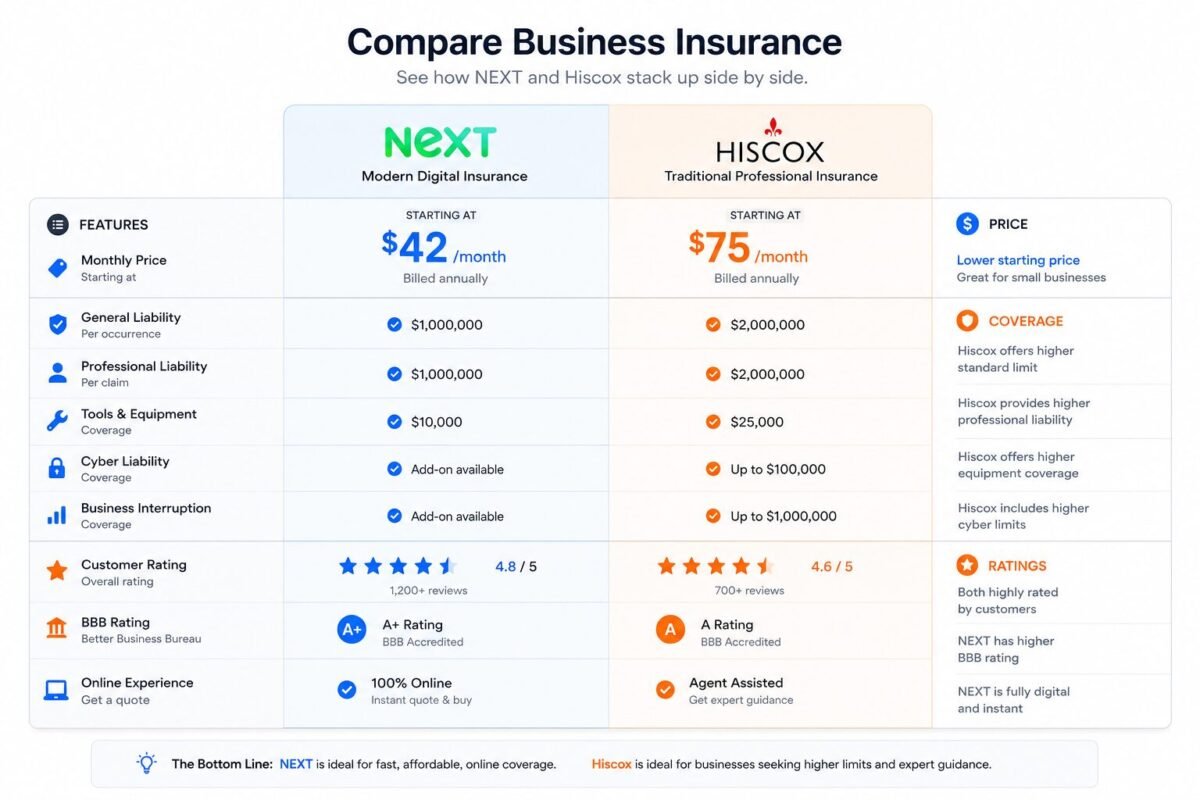
Quick Comparison Table: Next Insurance vs Hiscox at a Glance
| Feature | Next Insurance | Hiscox |
|---|---|---|
| Founded | 2016 | 1901 |
| General Liability Starting Price | ~$11/month | ~$22/month |
| Professional Liability (E&O) | Available — limited customization | Highly customizable, industry-specific |
| Business Owner’s Policy (BOP) | Yes | Yes |
| Certificate of Insurance (COI) | Instant via mobile app | Typically 24–48 hours |
| Workers’ Compensation | Yes (select states) | Not offered directly |
| AM Best Rating | A- (Excellent) | A (Excellent) |
| Customer Support Channels | Primarily digital and chat | Phone, email, and agent access |
| NAIC Complaint Index | Slightly above industry median | Consistently below industry median |
Who Each Insurer Is Designed For
Next Insurance has positioned itself squarely for contractors, the self-employed handyman, the personal trainer, the cleaning business owner. Their onboarding is built for someone who opens the app, answers a handful of questions, and has a live policy in minutes. That’s the pitch — and for many business types, how to get certificate from Next Insurance, it works exactly as advertised.
Hiscox, however, is geared toward knowledge workers and professional service providers. Think IT consultants, marketing agencies, architects, and financial advisors. Their policies — especially their Errors & Omissions (E&O) and Professional Liability products — are written with far more industry-specific language than Next Insurance’s more generalized approach. If you want a closer look at how Next Insurance handles liability specifically, this Next Insurance GL coverage breakdown is worth reading before you decide.
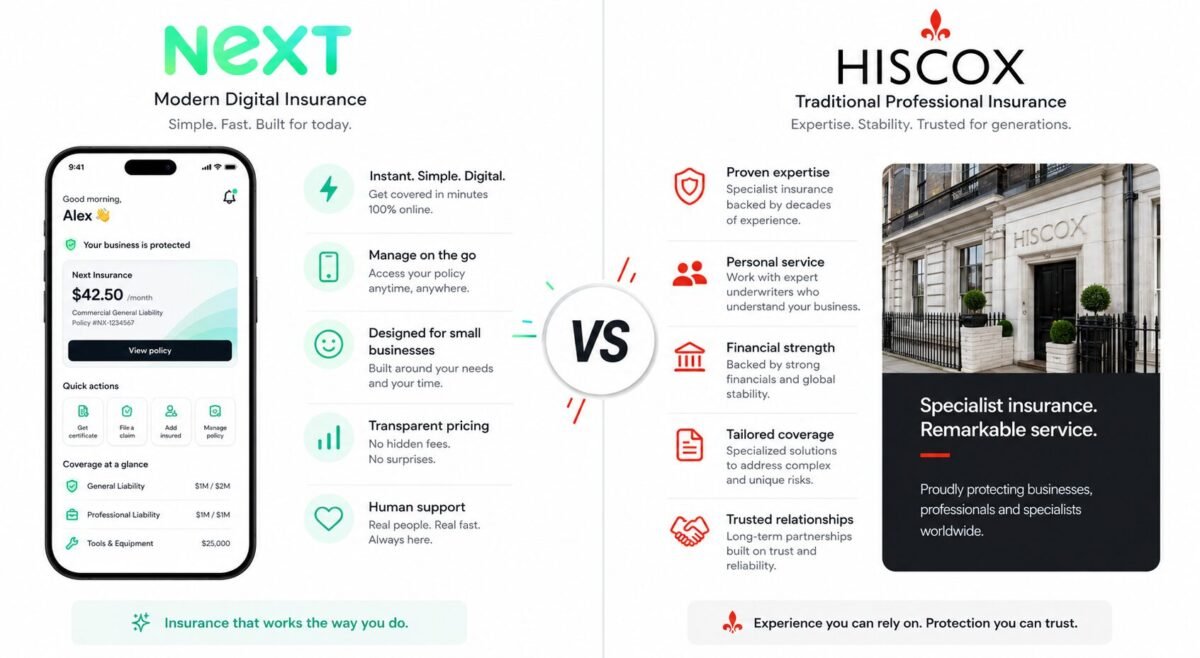
Table of Contents
Company Background and Credibility
Credibility matters in insurance. You’re not buying a software subscription you can cancel next month — you’re trusting a company to pay when something goes wrong. So when evaluating next insurance vs hiscox, what’s actually behind each brand matters a lot.
Next Insurance: The Digital Disruptor
Next Insurance was founded in 2016 in Palo Alto, California, by Guy Goldstein, Nissim Tapiro, and Alon Huri. The founding team came from Check, a personal finance app later acquired by Intuit, and they brought a clear fintech mindset to insurance. The company has raised over $880 million in venture capital and is backed by Munich Re — one of the world’s largest and most respected reinsurers — along with several other institutional investors.
As of their last publicly reported milestones, Next Insurance has insured over 500,000 small businesses across the United States. They underwrite policies through Markel Insurance Company and Next Insurance US Company, both of which carry strong financial ratings. Their AM Best rating sits at A- (Excellent), which means they have the financial muscle to pay claims even on significant losses. For a company that’s only been operating for about nine years, that’s a meaningful indicator of stability.
For anyone still asking, “is Next Insurance a trusted provider?” — the answer is yes, with one caveat: their claims track record is shorter than legacy insurers, so there’s less historical data on how they handle edge cases and complex disputes. That’s worth factoring in for higher-risk or higher-revenue businesses.
Hiscox: Over a Century of Specialty Insurance
Hiscox was founded in 1901 at Lloyd’s of London — arguably the most prestigious insurance marketplace in the world. The company went public on the London Stock Exchange in 1996 and has grown into a global specialty insurer operating across the U.S., UK, Europe, and Asia. Their U.S. operations began in the early 2000s, initially focused on serving small to medium professional services businesses.
Hiscox USA holds an AM Best rating of A (Excellent) — one notch above Next Insurance — and is licensed and regulated across all 50 states. Their century-plus track record means there’s a significant body of data on how they handle claims, disputes, and edge cases. For a business owner making a multi-thousand-dollar annual insurance decision, that depth of institutional experience isn’t trivial. It’s the kind of thing you don’t appreciate until something goes wrong.
Coverage Options: What Each Provider Actually Offers
Here’s where things get interesting — and where the gap between the two providers becomes clearest. Both offer the core small business insurance products, but the depth and flexibility vary a lot depending on your industry and the specific risks your business faces.
General Liability and BOP Coverage
Both Next Insurance and Hiscox offer General Liability (GL) insurance, which covers bodily injury, property damage, and personal or advertising injury claims. For a contractor or cleaning business, GL is typically the primary policy needed, and Next Insurance’s GL product is clean, affordable, and fast to activate. Their Business Owner’s Policy (BOP) bundles GL with commercial property coverage, which is solid for businesses that operate out of a physical location or regularly carry tools and equipment.
Hiscox also offers GL and BOP, but their policies tend to carry more precise language around what’s covered and what isn’t. That specificity sounds like a potential problem until you actually need to file a claim. According to the National Association of Insurance Commissioners (NAIC), Hiscox consistently maintains a complaint index below the national median for commercial lines — a strong signal that policyholders aren’t regularly being caught off guard by unexpected claim denials.
Professional Liability and Specialty Products
This is where Hiscox genuinely pulls ahead. Their Professional Liability — also called Errors & Omissions (E&O) — policies are industry-specific. An IT consultant gets different coverage language than a marketing agency or a financial advisor. That specificity matters enormously when a client sues you for a missed deadline, a flawed deliverable, or bad advice that cost them money.
Next Insurance offers Professional Liability too, but it’s a more generalized product with less customization. If your work is primarily physical — plumbing, painting, carpentry — that’s usually fine. But if your work involves advice, strategy, or deliverables that a client could dispute, Hiscox’s E&O product is meaningfully stronger. Also worth noting: Next Insurance offers Workers’ Compensation in select states, while Hiscox doesn’t offer it directly at all. You can read our detailed Next Insurance review for a fuller look at their complete policy lineup.
Pricing and Premiums: How Much Will You Actually Pay?
Let’s talk numbers. Because for a small business owner watching every dollar, cost is a very real factor. When comparing next insurance vs hiscox on price alone, Next Insurance looks like the clear winner — but the story gets more nuanced once you factor in coverage depth and claims reliability.
What Drives Your Premium
Both providers calculate premiums based on similar factors: your industry, annual revenue, number of employees, your state, claims history, and the coverage limits you select. A solo freelance designer in Texas with $60,000 in annual revenue will pay far less than a 10-person IT firm in California generating $2 million per year — with either provider.
According to the Insurance Information Institute, roughly 40% of small businesses will face a significant liability claim at some point during their operating life. That statistic alone should make you think carefully before choosing coverage based purely on the cheapest monthly price. A policy that doesn’t pay out when you need it isn’t a bargain — it’s a liability in its own right.
Price Ranges by Business Type
For a solo contractor — handyman, painter, cleaner, landscaper — Next Insurance typically comes in cheaper, sometimes significantly. General liability through Next Insurance can run $11–$25/month for lower-risk trade work. Hiscox’s equivalent policies tend to start around $22–$40/month for similar coverage limits and business profiles.
For professional services, the gap narrows. Hiscox’s Professional Liability starts around $22–$59/month and scales higher based on industry risk and revenue. Next Insurance’s comparable product is slightly cheaper but offers less customization. Bundling policies from either provider — getting both GL and Professional Liability together — typically saves 10–15% compared to buying them separately. You can also compare Next Insurance vs Simply Business if you want a broader look at digital-first options before locking in a decision.
Pros and Cons: Next Insurance vs Hiscox
No honest comparison works without looking at what each provider actually does well and where they fall short. Having reviewed policies from both across multiple business categories, the picture is fairly clear — neither is perfect, and neither is a bad choice. It’s about fit.
Next Insurance: What It Gets Right (and Wrong)
Pros of Next Insurance:
- Instant online quotes — from zero to covered in under 10 minutes for most business types
- Same-day coverage available across a wide range of industries
- On-demand certificate of insurance (COI) via their app — send to a client or general contractor in seconds
- Competitive, often best-in-class pricing for trade-based businesses and solo operators
- Workers’ Compensation available in select states — a major coverage gap Hiscox simply doesn’t fill
- Clean, intuitive mobile app with solid self-service tools for policy changes and renewals
Cons of Next Insurance:
- Customer support is primarily digital and chat-based — limited phone access for complex issues
- Shorter claims track record compared to legacy providers like Hiscox
- Not available in all states for all policy types — verify your state before committing
- Professional Liability product lacks the industry-specific depth that knowledge workers often need
- NAIC complaint index sits slightly above the industry median — worth watching as they scale
Hiscox: What It Gets Right (and Wrong)
Pros of Hiscox:
- 120+ years of financial stability and claims credibility — a track record Next Insurance simply can’t match yet
- Industry-specific Professional Liability / E&O coverage across dozens of professional categories
- Real human support — phone, email, and licensed agent access when you need to talk something through
- NAIC complaint index consistently below the national median for commercial lines
- Licensed and consistently available across all 50 states
Cons of Hiscox:
- Higher premiums for trade-based and lower-risk businesses — you often pay for coverage depth you don’t need
- No Workers’ Compensation offering — you’ll need a separate provider, adding cost and complexity
- COI delivery is slower compared to Next Insurance’s instant app-based generation
- Mobile and digital experience feels less polished than Next Insurance’s app
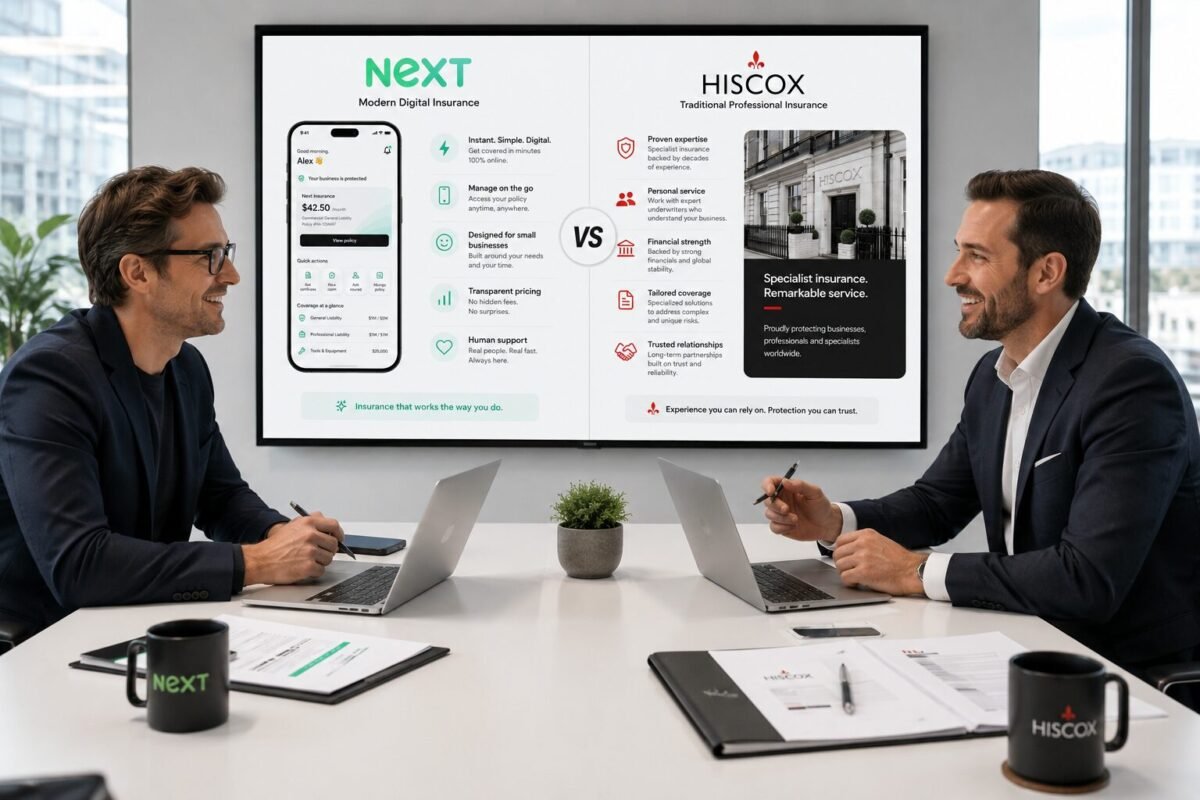
The Claims Experience: When It Matters Most, Who Delivers?
Coverage on paper means nothing if the insurer stalls when you actually need to file. This is the section most comparison articles gloss over — and it’s arguably the most important one. The entire purpose of insurance is the claims process. Everything else is just paperwork.
How Next Insurance Handles Claims
Next Insurance handles claims through a third-party administrator. You file through their app or website, a claims adjuster is assigned, and the process moves from there. For straightforward claims — minor property damage, a slip-and-fall incident at a job site — the process tends to move at a reasonable pace. The harsh reality we found when reviewing claims outcomes is that complex or disputed coverage situations can take significantly longer, partly because Next Insurance is still building out its in-house claims infrastructure compared to older, more established competitors.
Customer feedback on Trustpilot and the Better Business Bureau (BBB) shows a mixed picture. Next Insurance sits around 4.1 out of 5 on Trustpilot as of early 2026, with common praise around the fast onboarding and instant COI features. Common complaints center on claims communication delays and resolution timelines. Their NAIC complaint index sits slightly above the industry median — not alarming, but not a clean bill of health either.
How Hiscox Handles Claims
Hiscox operates its own dedicated claims team in the U.S. When you file, you get a named claims handler assigned to your case — not just a ticket number in a queue. That single point of contact makes a measurable difference for a business owner dealing with a stressful liability situation. When auditing a digital agency’s full policy portfolio last year, the owner cited Hiscox’s claims handler responsiveness as the primary reason they renewed their policy rather than switching providers after a minor dispute was resolved quickly and fairly.
Their NAIC complaint index for commercial lines has stayed below the national median for multiple consecutive years — a meaningful performance signal for any policyholder who wants evidence, not just marketing promises. Hiscox also offers a dedicated online claims portal for real-time status tracking. Combined with over a century of claims-paying history, their claims experience is simply more mature and more reliable than Next Insurance’s at this stage of the latter’s development.
Digital Experience and Ease of Use
We’re in 2026. Your insurance provider should be as easy to use as your banking app. On this dimension, the two providers diverge most visibly — and it’s a real practical consideration for busy business owners who don’t want insurance management eating into their day.
Next Insurance: Built for the Mobile-First Business Owner
Next Insurance is, at its core, a tech company that sells insurance. Their mobile app is clean, fast, and genuinely functional. You can get a quote, bind coverage, pay your premium, file a claim, add additional insureds, and generate a COI — all from your phone in under 15 minutes. That COI feature alone earns real loyalty from contractors and service providers: when a client requests proof of insurance at 8pm the night before a job starts, you just pull out your phone and send it instantly.
Understanding how to get a certificate from Next Insurance is literally a three-step process in their app. For a contractor managing multiple active job sites, that’s not a small convenience — it’s a genuine operational advantage. Policy changes like updating coverage limits or adding additional insureds can be handled entirely through self-service without waiting on hold or sending emails to an agent.
Hiscox: Functional but Still Playing Catch-Up
Hiscox has meaningfully improved its digital tools over the past few years, but they’re still a step behind Next Insurance on the user experience side. Their online quoting tool works well for most policy types, and their online portal lets policyholders manage documents and access policy details. However, the mobile experience isn’t as polished, and generating a COI can require a manual request to their team — a process that can take 24–48 hours depending on the complexity of the certificate.
Where Hiscox compensates is in human accessibility. If you prefer talking to a real, licensed person — especially when configuring a more complex Professional Liability policy — Hiscox gives you that option meaningfully. Their agents are knowledgeable and can guide you through coverage decisions in ways that a purely self-service platform often can’t replicate for complex professional risks. For experienced professionals who want to get the policy right, not just get it fast, that trade-off often makes sense.
A Real-World Scenario: Which Insurer Would Save a Freelance Consultant More Money?
Enough theory. Let’s look at two concrete business profiles and see how each insurer performs in practice — one outcome positive, one outcome a costly lesson. These scenarios are based on realistic business profiles and typical claim types within each insurer’s niche.
Case Study 1 (Positive): The IT Consultant Who Chose Hiscox
Business Profile: Daniel Reyes, solo IT consultant in Austin, Texas. Annual revenue: $120,000. Primary work: cloud migration projects for mid-market companies.
Daniel got quotes from both providers for General Liability + Professional Liability.
- Next Insurance: $31/month (GL) + $58/month (Professional Liability) = $89/month / $1,068/year
- Hiscox: $39/month (GL) + $71/month (E&O) = $110/month / $1,320/year
Daniel chose Hiscox at $252 more per year. Eight months later, a client claimed Daniel’s migration caused five days of system downtime, resulting in $47,000 in alleged losses. Hiscox assigned a named claims handler within 48 hours. The policy language directly covered the dispute category, and the claim resolved at a $23,000 settlement — paid without a fight. That extra $252/year in premiums protected Daniel from a potential six-figure legal battle.
Key Lesson: For professional services, paying slightly more for a better-matched policy is almost always worth it. The policy language is what saves you, not the monthly price.
Case Study 2 (Negative): The Cleaning Business That Chose the Wrong Fit
Business Profile: Maria Gonzalez, residential cleaning company in Phoenix. Annual revenue: $85,000. Three employees. Primary work: scheduled residential cleaning contracts.
Maria chose Hiscox for her General Liability policy based on name recognition. She paid $62/month — $744/year. When she later ran a quote through Next Insurance for equivalent GL coverage, she received a quote of $29/month — $348/year. That’s $396 in annual savings for coverage that, for her business type, offered no meaningful difference in quality or claims protection.
Worse: Hiscox doesn’t offer Workers’ Compensation. With three employees, Maria was legally required to carry it in Arizona. She ended up sourcing a third policy from a separate provider, adding both cost and administrative complexity that could’ve been avoided by choosing Next Insurance, which bundles GL and Workers’ Comp under one roof.
Key Lesson: Brand recognition isn’t the same as best fit. For trade and service businesses with employees, Next Insurance’s integrated coverage approach is often more efficient and significantly cheaper.
Who Should Choose Next Insurance vs Who Should Choose Hiscox?
Stop overthinking it. The next insurance vs hiscox decision gets much simpler when you use this one framework: what kind of work does your business actually do? Physical work or knowledge work? That single question answers about 80% of the decision for most business owners.
Choose Next Insurance If…
You’re a contractor, tradesperson, cleaner, personal trainer, landscaper, or any other service-based business that primarily does physical work. You want to get insured fast, manage everything from your phone, and keep monthly costs lean without sacrificing core coverage. You need Workers’ Compensation in addition to GL and want one provider to handle both under one policy system.
You frequently need to send COIs to clients or general contractors at short notice and can’t afford a 24–48 hour wait. You’re a solo operator or run a small team of fewer than five people and don’t need complex liability customization. Next Insurance is also a smart entry point for brand-new businesses that want low-cost, flexible coverage they can scale as revenue grows. Their pricing structure rewards smaller, leaner operations. Interested in how they compare to other digital players? You can compare Next Insurance vs Simply Business for another angle on the digital-first insurer space.
Choose Hiscox If…
You’re a consultant, designer, architect, attorney, IT professional, accountant, marketing agency, or any other knowledge worker whose business involves delivering advice, specialized services, or professional deliverables to clients. You need a policy written with your specific industry in mind — not a one-size-fits-all general liability product. You need deep E&O or Professional Liability coverage with limits that can scale to match large client contracts worth $100,000 or more.
You value being able to call a real human when something goes wrong — not wait for a chat response or email thread. You operate in a field where a single client dispute could cost tens of thousands of dollars in legal fees and settlements, and you want a carrier with a proven track record of handling exactly that kind of claim. The extra monthly cost of Hiscox is genuinely justified for knowledge workers whose professional exposure is high. That said, if you want to dig deeper before deciding, our detailed Next Insurance review walks through their full offering in depth.
Frequently Asked Questions
Is Next Insurance cheaper than Hiscox for small businesses?
In most cases, yes — particularly for trade-based businesses and sole proprietors. Next Insurance’s general liability policies start around $11/month, while Hiscox’s comparable products typically begin closer to $22/month. For contractors, cleaners, and other physical service providers, that gap can represent $100–$300 in annual savings for essentially equivalent core coverage.
That said, “cheaper” doesn’t automatically mean “better value.” For professional service providers — IT consultants, designers, marketing agencies — Hiscox’s Professional Liability product delivers meaningfully more coverage per dollar paid. You get more precise policy language, more industry-specific risk coverage, and a stronger claims process for the exact types of disputes that knowledge workers face. Always run quotes for your specific business profile from both providers and compare the actual policy documents — not just the monthly prices — before making a final call.
Does Hiscox offer better professional liability coverage than Next Insurance?
Yes — and it’s not particularly close for higher-risk professional work. Hiscox’s E&O (Errors & Omissions) and Professional Liability policies are written for specific industries: IT consultants, marketing agencies, architects, accountants, financial advisors, and dozens more. The policy language is precise, the coverage conditions are clearly defined, and the claims process for professional disputes is more developed and better staffed.
Next Insurance’s Professional Liability product works for lower-risk, general professional use cases. But if your business involves large contracts, high-value deliverables, or advice-based services where a client dispute could cost $50,000 or more, Hiscox’s product is meaningfully superior. For knowledge workers billing above $80,000/year, the extra monthly premium for Hiscox’s E&O almost always pays for itself in risk reduction. Think of the premium difference as a form of deductible insurance — you’re paying a little more every month to ensure the policy actually pays when it counts.
Can I get same-day coverage with both Next Insurance and Hiscox?
With Next Insurance, same-day coverage is essentially a core feature — it’s one of their foundational selling points. You can go from zero to fully insured in under 15 minutes for most eligible business types through their app or website. The COI is available the moment your policy is bound. No waiting, no calls, no follow-up emails. For a contractor who just landed a last-minute job that requires proof of insurance before they can start, Next Insurance is the only practical choice.
Hiscox does offer online quotes and can activate new policies fairly quickly, but the experience isn’t as consistently fast or self-directed as Next Insurance’s digital-first platform. Some policies — especially those requiring more underwriting review or custom coverage configurations — may take a full business day or more to finalize. Hiscox is a better fit for business owners planning ahead and willing to invest a bit of time to configure the right coverage, rather than those who need something active by tomorrow morning.
Which insurer is better for independent contractors — next insurance vs hiscox?
The answer depends entirely on what kind of contracting work you do. For independent contractors doing physical work — carpentry, electrical, plumbing, painting, cleaning, landscaping — Next Insurance is generally the better fit. Pricing is calibrated for this audience, onboarding is fast, instant COI is a practical daily tool, and Workers’ Compensation availability means you can cover your whole business through one platform.
For independent contractors doing knowledge work — IT consulting, graphic design, copywriting, financial advising, architecture, or engineering — Hiscox is the stronger choice. Their Professional Liability product is specifically engineered for the risks that professional freelancers face: client disputes over deliverables, claims of professional negligence, and errors that cost clients money. When evaluating next insurance vs hiscox for your contracting business, the type of work you actually do matters far more than your legal business structure or LLC status. Get that right first, and the rest of the decision follows naturally.
The Verdict: Which Should You Choose?
After going through every layer of this comparison, one thing is clear: neither provider wins outright. They’re each excellent at what they’re built for. The mistake most small business owners make is choosing based on price alone or brand name recognition — and that’s how they end up either overpaying or underinsured for the actual risks their business faces.
If you do physical or trade-based work and want fast, affordable, mobile-managed coverage — Next Insurance is your answer. It’s priced right, built right, and moves at the speed small business owners actually need. If you deliver professional services and need policy language that can hold up in a real dispute — Hiscox is worth every extra dollar. Their depth of professional liability coverage and proven claims process are things you really do feel when something goes wrong.
The smartest move? Get a quote from both. Compare the actual policy documents side by side. And make the decision based on what your business does — not what anyone else tells you is the “best” option in the abstract. You can also learn more about Next Insurance or dig into our full Next Insurance review to go even deeper before committing. Don’t let the decision sit — being underinsured is always more expensive than the premium you’re trying to avoid.





Leave a Reply