
Editorial Disclosure: This article may contain affiliate links. We may earn a commission if you make a purchase, at no extra cost to you. Additionally, this content was drafted with the assistance of AI technology, but has been rigorously reviewed, fact-checked, and edited by our editorial team to ensure accuracy and quality.
Quick Answer
AI insurance CRM trends 2026 are defined by agentic AI that runs quote-to-bind and renewal workflows on its own, predictive lead scoring and churn prediction that flag risk months early, and conversational voice AI across the policy lifecycle — all now fenced in by explainability rules from the EU AI Act and the NAIC Model Bulletin.
- Agentic AI is the headline shift: Gartner expects 40% of enterprise applications to embed task-specific AI agents by the end of 2026, up from under 5% in 2025.
- Predictive analytics now sit at roughly 74% adoption among insurers, powering lead scoring, cross-sell timing, and lapse prediction 60–90 days out.
- The money is real: McKinsey estimates generative AI could add $50–$70 billion in annual insurance revenue, concentrated in marketing and customer operations.
- Compliance is the gate: 24+ U.S. states plus DC have adopted the NAIC AI bulletin, and EU insurance pricing AI is classified high-risk under the AI Act.
Here’s the part nobody puts on the sales deck. The tools are ready. Most agencies aren’t. Over my seven years running digital strategy for agencies and carriers, I’ve watched more AI rollouts stall in month four than fail at launch — and it’s almost never the model’s fault. So before you sign a per-seat contract, let’s get into what’s actually changing, what’s hype, and the one trap that quietly tanks retention. If you’re still standardizing your insurance CRM foundations, start there first.
Why 2026 Is the Real Inflection Point for AI in Insurance CRM
Ask yourself one question. What actually changed between 2024 and now? Back then, “AI in the CRM” mostly meant a copilot that drafted emails while a human did the real work. Helpful. Not transformative. 2026 is different because three separate curves crossed at the same moment: the technology hit production reliability, the data finally got consolidated, and the regulators showed up with deadlines. That combination is why this year reads less like an upgrade and more like a reset.
Why the AI Insurance CRM Trends 2026 Shift Is Structural, Not Hype
Adoption numbers tell the story. Conning’s 2025 industry survey found roughly 90% of insurers somewhere on the generative AI journey, with about 55% in early or full deployment. But here’s the uncomfortable second number: industry analyses suggest only around 22% have scaled AI beyond isolated pilots. The gap between “we’re experimenting” and “it runs in production with measured P&L impact” is enormous — and closing that gap is the entire game this year. The winners aren’t the ones with the fanciest model. They’re the ones who cleaned their data and picked one workflow to actually finish. According to McKinsey, generative AI could generate $50–$70 billion in additional insurance revenue, with the sharpest impact on marketing, sales, and customer operations — the exact functions your CRM touches.
Three Clocks Ticking at Once
Clock one: data. Policy, claims, and marketing systems that lived in separate silos are being pulled into unified customer profiles, often through a customer data platform. Without that, AI just automates chaos faster. Clock two: regulation. The EU AI Act and the NAIC Model Bulletin both moved from “coming soon” to enforceable governance expectations, which I’ll break down shortly. Clock three: margin. With loss ratios under pressure, boards want efficiency now, not a two-year proof of concept. When those three pressures hit at the same time, “wait and see” stops being a strategy. It becomes a competitive liability. That’s the honest reason 2026 is the pivot — not because a vendor said so.
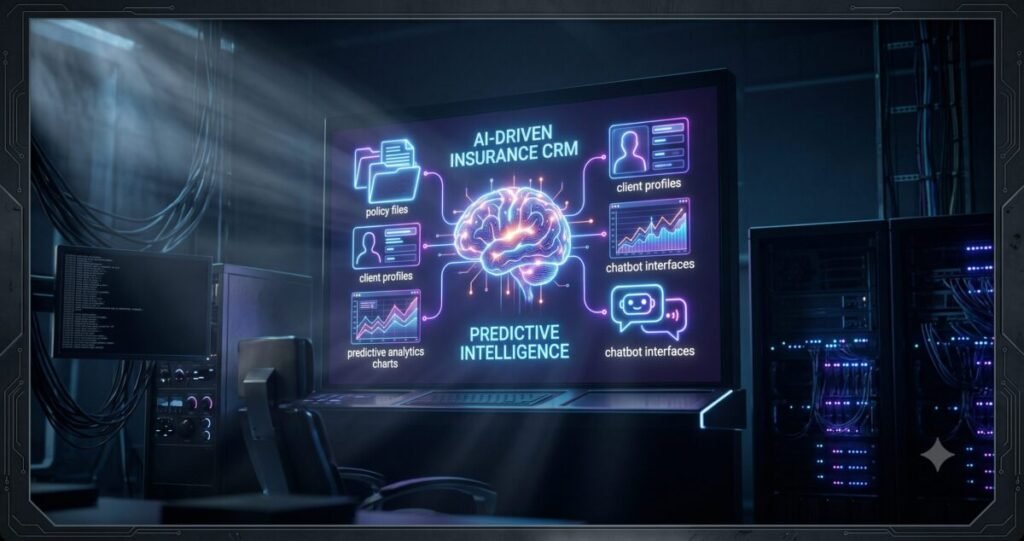
Table of Contents
The Core AI Insurance CRM Trends Defining 2026
Enough context. Let’s get specific. When people search AI insurance CRM trends 2026, these three shifts are what they’re really asking about — and I’m framing each as a movement from where we were to where we’re headed, because that’s what a “trend” should actually mean.
Agentic AI: From Copilots to Autonomous Quote-to-Bind and Renewals
This is the big one. A copilot waits for you. An AI agent acts. This year, agentic systems inside the CRM can triage an inbound lead, notice missing information, ask the prospect for it, generate a quote for a straightforward risk, and queue the renewal — all before a human opens the record. Gartner projects that 40% of enterprise applications will embed task-specific AI agents by the end of 2026, up from under 5% a year earlier. Here’s where the line sits in practice: an agent can bind a simple monoline policy and cut quote-to-bind time from days to hours, but it should hand a complex commercial submission straight to an underwriter with a summary attached. The skill isn’t turning autonomy up to maximum. It’s deciding where autonomy stops. Get that boundary wrong and you’ll feel it in complaints. Get it right and your team stops drowning in data entry. This is where insurance CRM automation stops being a buzzword and starts removing actual hours from the week.
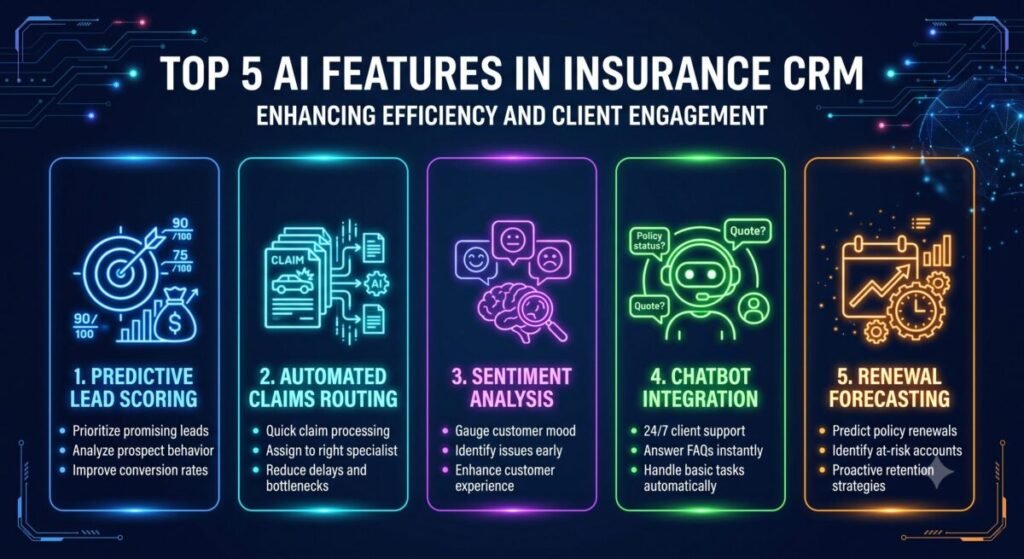
Predictive Lead Scoring, Cross-Sell Signals, and Pre-Emptive Churn Detection
Old scoring ranked leads on demographics. New scoring predicts behavior. Machine learning models — now around 74% adoption across insurers — rank policyholders by likely lifetime value, surface the exact window when a customer is ready for an umbrella or a second policy, and flag lapse risk 60 to 90 days before renewal. Picture a homeowners client whose payment pattern shifts and whose engagement drops. The model doesn’t wait for them to leave. It drops a retention task into the agent’s queue with a suggested next step. What I’ve noticed in actual practice is that these signals are only as good as the CRM data feeding them. Feed a predictive engine duplicated, half-empty records and it will confidently rank noise. That’s not a model problem. That’s a foundation problem — and it’s why the boring data work pays the highest dividend.
Conversational and Voice AI Across the Policy Lifecycle
Text chatbots were step one. Voice AI is step two. In 2026, AI voice agents handle after-hours intake, first-notice-of-loss calls, and routine renewal check-ins without a hold queue. The interesting layer is sentiment analysis: when a caller’s tone signals frustration or a claim turns emotionally heavy, the system routes them to a human immediately instead of trapping them in a bot loop. Does that mean you automate every call? No. And this is exactly where the EU AI Act’s transparency rule bites — from August 2026, a chatbot generally has to disclose that it isn’t human. Hiding the bot isn’t just bad manners now. It’s a compliance exposure.
AI Insurance CRM Trends 2026: Traditional vs Next-Gen at a Glance
If you want the shift in one view, here’s how a legacy insurance CRM stacks up against an AI-native one this year:
| Capability | Traditional Insurance CRM | AI Insurance CRM (2026) |
|---|---|---|
| Lead scoring | Static rules and demographics | Predictive, behavior-based, self-updating |
| Quote-to-bind | Manual, days for simple risks | Agentic, hours or minutes for simple risks |
| Churn management | Reactive, after a lapse happens | Predictive, flagged 60–90 days early |
| Customer contact | Business-hours, human-only | 24/7 voice and chat with human handoff |
| Compliance posture | Manual logs, hard to audit | Explainable outputs with audit trails |
The Compliance and Explainability Trend Most Vendors Are Quietly Underselling
Here’s what the feature demos skip. If your AI CRM declines a lead or nudges a price and nobody on your team can explain why, that’s not innovation. That’s a liability with a subscription fee. Explainability moved from academic nicety to purchase criterion this year, and the AI insurance CRM trends 2026 story is incomplete without it.
Why “Explainable” Is Now a Buying Requirement, Not a Nice-to-Have
Explainable AI matters because insurance decisions carry adverse-action consequences. When a model influences who gets a quote, what they pay, or whether a claim gets flagged, regulators expect you to show your work. Ask any vendor three questions before you buy. Can it produce a plain-language reason for each recommendation? Can it log every automated decision for audit? Can it demonstrate testing for bias and unfair discrimination? If the answer is a shrug and a mention of “the algorithm,” walk away. A black-box CRM that can’t justify a declined applicant is a market-conduct exam waiting to happen. And “the vendor’s model did it” is not a defense that holds up — as the deployer, you carry your own obligations.
The EU AI Act and NAIC Reality Check
Let’s ground this in real rules. In the U.S., the NAIC Model Bulletin on the use of AI by insurers — adopted in December 2023 — has now been taken up by at least 24 states plus the District of Columbia, and the NAIC’s AI Systems Evaluation Tool entered pilot examinations in early 2026. Translation: examiners are moving from writing guidance to actually checking. On top of that, Colorado requires quantitative bias testing, New York’s DFS expects proxy-discrimination analysis, and California limits sole AI reliance on health coverage denials. In the EU, the EU AI Act classifies AI used for risk assessment and pricing in life and health insurance as high-risk. Those obligations were set to apply from August 2, 2026, though the EU’s Digital Omnibus — provisionally agreed in May 2026 and pending formal adoption — would push the deadline for these standalone systems to December 2, 2027. The chatbot transparency rule still lands in August 2026. The takeaway isn’t the exact date. It’s that governance is now a design requirement, not a paperwork afterthought.
The Contrarian Take: Why “AI-First” Insurance CRM Is Backfiring for Some Agencies
Time for the unpopular opinion. “AI-first” is quietly hurting a subset of agencies, and no vendor will say it out loud. Not because AI is bad. Because they’re pointing it at the wrong things. If I could give one warning about the AI insurance CRM trends 2026 rush, it’s this: automation applied to the wrong touchpoint doesn’t save money. It leaks customers.
The Trust-Erosion Trap
Insurance runs on trust, especially at two moments: renewals and claims. Those are precisely the moments where over-automation stings. When a long-time policyholder gets a cold, obviously-automated renewal — or worse, a bot handling the emotional weight of a claim — retention quietly erodes. I’ve watched a fully automated renewal sequence lift efficiency metrics while Net Promoter Score and retention slid in the same quarter. The dashboard looked great. The book was bleeding. Efficiency and loyalty are not the same number, and confusing them is how “AI-first” backfires. Who should not rush? Small agencies whose entire edge is the personal relationship. If a human touch is your moat, don’t let a bot fill the moat.
Garbage In, Garbage Out — at Machine Speed
The second trap is data. Stack a powerful model on dirty, duplicated CRM records and you don’t get intelligence. You get errors, amplified and automated. Then there’s the cost nobody quotes: integration, ongoing model monitoring, and compliance overhead that hides behind a friendly per-seat price. The total cost of ownership of an AI CRM is rarely the license. It’s the maintenance. My honest advice after seven years of this? If your data is a mess, fixing the data will outperform buying the AI. Every time. Boring, I know. It’s also true.
Real-World Scenarios: Success vs. Failure
Theory is cheap. The AI insurance CRM trends 2026 look clean on a slide and messy in production, so let’s look at two patterns I’ve seen play out — one that worked, one that didn’t. Names withheld, numbers representative of what these rollouts actually produce.
The Success Pattern: Data-First, Human-in-the-Loop
A mid-size agency did the unglamorous thing first. They spent six weeks deduplicating records and unifying their contact data before touching AI. Then they deployed one capability — predictive churn scoring — with a rule: every at-risk flag routed to a human agent with a suggested action, never an automated goodbye. Results over two quarters: response time on at-risk accounts dropped sharply, and renewal retention on the flagged segment climbed by a meaningful margin because agents were reaching people before they shopped around. Key lesson: they treated AI as an early-warning system for humans, not a replacement for them. Clean data first, one workflow, human in the loop. That sequence is the whole trick.
The Failure Pattern: Automation Over Trust
A regional carrier went the other direction. They automated renewals and claims communication end-to-end, chasing headcount savings, and skipped the explainability step. Two things broke. First, NPS and retention dropped as customers felt processed instead of served — the empathy vanished at exactly the wrong moments. Second, an applicant was declined by a model the team couldn’t explain, which surfaced as a compliance flag during review. Cost savings on paper. Trust and exposure problems in reality. Key lesson: automating the emotional, high-stakes touchpoints — and skipping auditability — is how a “modern” rollout becomes a cautionary tale. Efficiency without trust is a short-term win and a long-term bill.
Strategic Implementation and Best Practices
So how do you get the upside without the traps? Here’s the playbook I’d hand any agency chasing the AI insurance CRM trends 2026 without setting money on fire. It’s a sequence, not a shopping list.
Build the Clean, Unified Data Foundation First
Step zero, before any AI: fix the data. Deduplicate records. Standardize fields. Pull policy, claims, and marketing data into one unified profile, ideally through a customer data platform. AI stacked on clean data compounds. AI stacked on mess just fails faster. If you haven’t structured this yet, the guide on how to set up a CRM for your insurance agency walks through the groundwork before you ever layer intelligence on top. Skip this and every later step wobbles.
Human-in-the-Loop Guardrails That Protect Retention and Compliance
Decide upfront which touchpoints stay human. My rule of thumb: automate the routine and repetitive, keep humans on the emotional and consequential. Use confidence-threshold routing — when the model isn’t sure, it escalates to a person instead of guessing. Log every automated decision for auditability. Keep adverse-action reasoning in plain language. These guardrails do double duty: they protect the customer relationship and they satisfy the NAIC and EU AI Act expectations at the same time. Retention and compliance, one design choice.
The 90-Day AI CRM Adoption Blueprint
Don’t boil the ocean. Here’s a 90-day approach that actually ships:
- Days 1–30: Audit and clean CRM data; pick one high-volume, low-risk workflow (churn scoring or first-notice-of-loss triage are strong starts).
- Days 31–60: Deploy that single workflow with human-in-the-loop guardrails; define KPIs — response time, retention on flagged accounts, quote-to-bind speed.
- Days 61–90: Measure against a baseline, fix what breaks, then expand to a second workflow. Run vendor due diligence on explainability, data residency, integration, and true total cost.
Pilot. Measure. Expand. That rhythm beats a big-bang rollout every single time.
What’s Next: AI Insurance CRM Beyond 2026
Where does this go next? Not science fiction — just the near, grounded future. The AI insurance CRM trends 2026 are laying track for a few things worth preparing for now.
Multi-Agent Orchestration
Today it’s one agent doing one job. Next it’s several specialized agents coordinating — one pulling risk data, one pricing, one handling follow-up — with a human supervising the whole ensemble. Deloitte has described this as a “multi-agent ecosystem” spanning the value chain. For CRM, that means the system stops being a place you check and becomes a set of workers you oversee. The practical move today: build the clean data and guardrails those agents will depend on tomorrow.
Embedded, Real-Time Signals Feeding the CRM
The other shift is data getting live. Telematics, IoT, and embedded-insurance signals will feed the CRM in real time, enabling hyper-personalized policy bundling and pricing that reflects actual behavior rather than a snapshot from last year. Add tightening global AI governance, and one prediction is safe to act on: the agencies that win won’t be the ones with the most AI. They’ll be the ones who paired it with the cleanest data and the clearest human judgment. Start there now and the future gets a lot less intimidating.

Frequently Asked Questions
What is the difference between an AI insurance CRM and a traditional insurance CRM in 2026?
A traditional insurance CRM stores and organizes data; an AI insurance CRM acts on it. The traditional version is a filing cabinet with reminders — you do the analysis. The AI-native version predicts churn, scores leads by behavior, runs agentic quote-to-bind for simple risks, and handles voice and chat around the clock, while flagging consequential decisions for a human. The shift is from record-keeping to decision support.
Which AI insurance CRM trends 2026 features actually improve policy retention?
The features that move retention are predictive churn detection with human follow-up, behavior-based lead scoring, and well-timed cross-sell prompts. Among the AI insurance CRM trends 2026, the retention winners share one trait: they route the AI’s insight to a human at the emotional moments rather than automating those moments away. Predict early, let a person reach out. Automating the renewal call itself usually does the opposite of what you want.
Is agentic AI in an insurance CRM compliant with the EU AI Act and NAIC guidelines?
It can be, but compliance depends on how you deploy it, not the label. Under the NAIC Model Bulletin — now adopted by 24-plus states — and the EU AI Act, insurers must maintain governance, explainability, bias testing, and audit trails. Agentic AI is allowed on low-risk, high-volume steps; the safe pattern keeps humans on consequential decisions and logs every automated one. Remember, as the deployer, that obligation is yours, not just the vendor’s.
How much does an AI-powered insurance CRM cost for a small agency in 2026?
There’s no single sticker price, and the license is the smallest part. For a small agency, expect the real cost to include integration, data cleanup, ongoing model monitoring, and compliance overhead on top of per-seat fees. Start small — one workflow, measured over 90 days — so you’re paying for value you can verify rather than a full-suite bet. The cheapest mistake is buying big before your data is ready.
The AI insurance CRM trends 2026 reward preparation, not panic. If you take one action this week, make it an honest audit of your CRM data — because clean records are the foundation every other trend on this list depends on. Fix that first, pick one workflow, and let the results earn the next step.





Leave a Reply