
Editorial Disclosure: This article may contain affiliate links. We may earn a commission if you make a purchase, at no extra cost to you. Additionally, this content was drafted with the assistance of AI technology, but has been rigorously reviewed, fact-checked, and edited by our editorial team to ensure accuracy and quality.
Quick Answer
AI in InsurTech startups is fundamentally restructuring how insurance is priced, sold, and settled — replacing slow, paper-heavy processes with real-time, data-driven automation that actually delivers results policyholders can feel.
- The global InsurTech market is projected to reach $166.4 billion by 2030, growing at a CAGR of over 30%.
- AI-powered claims processing can reduce settlement time from weeks to under 3 seconds in fully automated, straightforward cases.
- Fraud detection accuracy improves by up to 40% when AI replaces legacy rule-based systems.
- Usage-based insurance (UBI) models are growing at 23% annually, powered by AI, telematics, and real-time IoT data feeds.
What Is InsurTech and Why Does AI Change Everything?
AI in InsurTech startups isn’t just a buzzword — it’s the single biggest structural shift the insurance industry has faced in over a century. InsurTech, short for insurance technology, refers to startups using digital tools to simplify, speed up, or completely reimagine how insurance is bought, sold, and paid. For decades, insurance meant paper forms, long waiting periods, opaque pricing, and claims processes that dragged on for weeks. Early InsurTech founders set out to fix that. But here’s the thing: a better app wasn’t enough. What actually moved the needle was artificial intelligence.
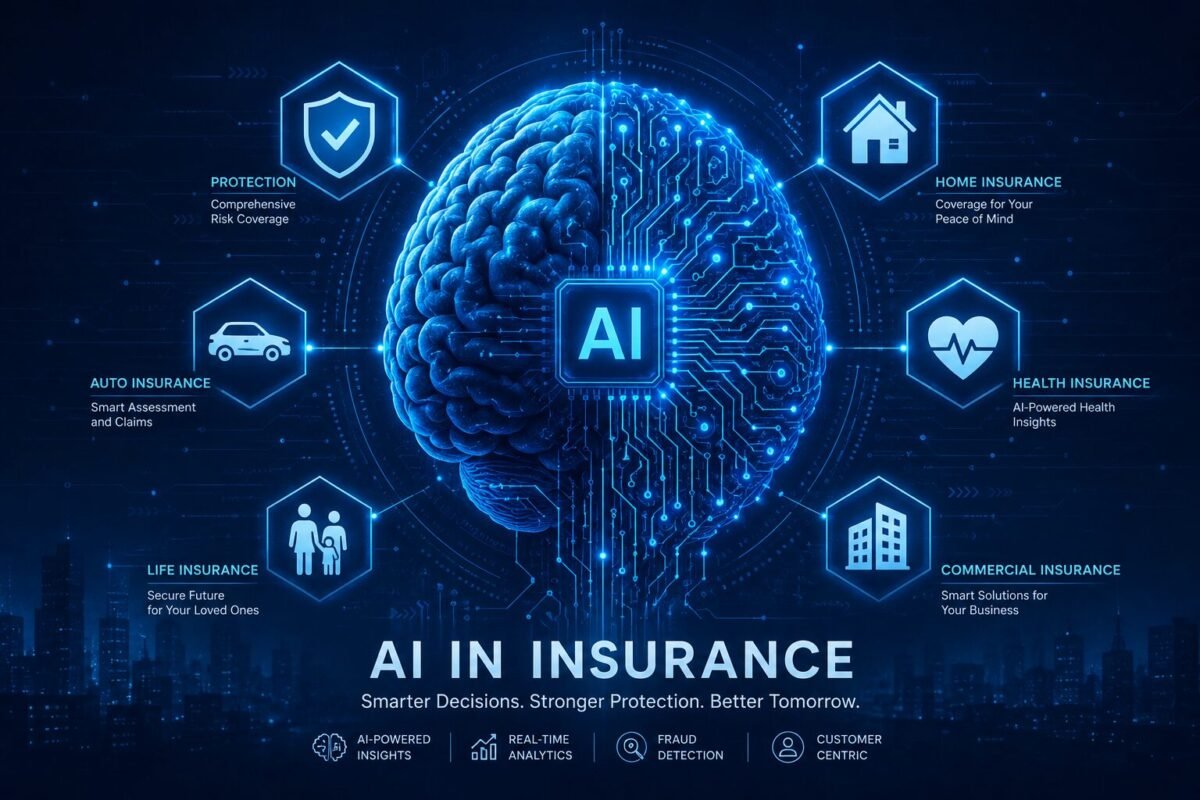
Table of Contents
Why Traditional Insurance Was Broken From the Inside
Legacy carriers relied on actuarial tables built from decades of aggregated demographic data. A 35-year-old male in Texas paid the same auto premium as every other 35-year-old male in Texas — regardless of how carefully he actually drove. That’s not risk assessment. That’s educated guessing at population scale. Underwriting could take days. Claims adjusters physically visited damaged properties. Fraud was caught mostly after the payout happened, if at all. The system wasn’t designed to be fast or personalized. It was designed to be defensible and predictable.
InsurTech startups spotted this gap early. The first wave focused on the interface layer — better mobile apps, faster onboarding, digital policy documents you didn’t need to print and mail back. That helped. But it didn’t fix the core engine. Pricing was still blunt. Claims were still slow. The hidden inefficiency costs stayed embedded in the system. AI is what actually changed the operating model underneath.
How AI Rewires the Entire Insurance Value Chain
Artificial intelligence doesn’t just speed things up — it changes what’s possible. Machine learning models can ingest thousands of data points (driving behavior, home sensor readings, medical wearables, satellite imagery of a roof) and return a risk score in milliseconds. Natural Language Processing lets AI systems handle policy inquiries, First Notice of Loss filings, and basic claims reviews without a human ever touching the ticket. Computer vision can assess car damage from a photo in seconds with accuracy that rivals a seasoned adjuster. None of this is incremental improvement. It’s a completely different operating model from top to bottom.
When auditing digital insurance workflows for a consulting engagement a few years back, the finding was stark: the biggest operational cost wasn’t the claims payouts themselves — it was the labor-intensive process of verifying, routing, and approving them. AI didn’t just reduce those costs. It eliminated entire process layers. That’s the real reason the rise of AI in InsurTech matters so much right now.
The Current State of AI in InsurTech Startups (2025–2026)
The numbers tell a clear story. According to Statista, global InsurTech investment has surged past $14 billion in recent funding cycles, with AI-centric companies capturing the largest share of venture capital. The space has matured dramatically since the early app-based experiments of 2015–2018. AI in InsurTech startups isn’t a feature anymore — it’s the foundation on which entire business models are built.
Where the Investment Is Actually Going
Venture capital is shifting toward InsurTech companies with proprietary AI models and defensible data assets. Pure-play AI insurers like Lemonade, Root, and Hippo have gone public and proven that AI-driven insurance businesses can reach meaningful scale. A second wave of B2B InsurTech startups — companies like Cytora, Federato, and Shift Technology — are selling AI infrastructure to traditional carriers who can’t build it fast enough internally. These aren’t small bets. Shift Technology alone has raised over $320 million to build fraud detection AI for the insurance industry.
The US, UK, and Germany lead in InsurTech funding and deployment. But growth markets in Southeast Asia and Latin America are accelerating fast, driven by mobile-first populations and historically low traditional insurance penetration. To get the full picture of where this industry is heading, explore all InsurTech trends of 2026 for a comprehensive breakdown of what’s driving growth across every major line of business.
From Pilot Programs to Production Infrastructure
In 2019, most InsurTech startups were experimenting with AI in narrow, low-stakes use cases — a chatbot here, a fraud flag there. By 2025, the conversation has shifted entirely. AI models now own full underwriting decisions for certain personal lines products. Automated claims platforms handle end-to-end settlement without a single human touchpoint for straightforward cases. The industry has moved from “AI as a pilot” to “AI as production-grade infrastructure that runs the business.” That shift has major implications for founders, investors, incumbents, and anyone who buys insurance.
Core AI Technologies Powering InsurTech Innovation
Not all AI is the same, and InsurTech startups aren’t using one monolithic system. They’re stacking multiple AI technologies across different layers of the business. Understanding which technology does what — and where the real value is being created — separates informed analysis from surface-level hype.
Machine Learning, NLP, and Computer Vision: The Core Stack
Machine learning is the backbone of AI underwriting. ML models analyze structured data (age, location, claims history, credit score) alongside unstructured signals (telematics, satellite imagery, social patterns) to generate real-time risk scores. The more data fed into these models, the sharper they become — which is exactly why data moats are the real competitive advantage in AI-driven insurance. A startup with two years of proprietary claims data has something a new entrant simply can’t buy overnight.
Natural Language Processing powers the conversational and document-processing layer. Whether it’s a policyholder asking about deductibles via a chatbot, or an AI system reading a claims report and extracting key liability details, NLP is running underneath. Lemonade’s AI system, Maya, handles thousands of simultaneous conversations without human involvement. Computer vision is the heavy-lifter for property and auto damage assessment. Tractable has built models that evaluate vehicle and property damage from smartphone photos with accuracy that rivals experienced field adjusters — and their systems process claims in seconds rather than days. Similarly, Kin uses AI for home risk assessment by processing aerial imagery, building permit records, and hyperlocal weather data to price residential properties with a precision no traditional underwriter could match manually.
Key AI Technologies in InsurTech: At a Glance
| AI Technology | Primary Use Case in Insurance | Leading InsurTech Example | Estimated Efficiency Gain |
|---|---|---|---|
| Machine Learning | Underwriting and real-time risk scoring | Root Insurance, Lemonade | 30–50% faster policy issuance |
| Natural Language Processing | Claims intake, chatbots, document extraction | Lemonade (AI Maya), Hippo | 60–80% reduction in manual intake labor |
| Computer Vision | Auto and property damage assessment | Tractable, Kin Insurance | Up to 4x faster damage evaluation |
| Predictive Analytics | Fraud detection and customer churn prevention | Shift Technology, Cytora | Up to 40% improvement in fraud catch rate |
| Robotic Process Automation | Back-office workflows and policy administration | Multiple carriers via third-party vendors | 50–70% cost reduction in operations |
How InsurTech Startups Are Using AI Across the Insurance Lifecycle
The real power of AI in InsurTech startups comes from deployment across every stage of the insurance journey — not just one isolated process. From the first quote to the final claims payment, AI is reshaping how each interaction works. And the compounding effect across the entire lifecycle is what creates a structural advantage over traditional carriers.
How AI in InsurTech Startups Is Redefining Underwriting
Traditional underwriting was a manual, judgment-heavy process. An underwriter pulled data, applied experience, consulted actuarial tables, and produced a quote — sometimes over days or even weeks for complex commercial lines. AI underwriting models compress this to seconds. They draw from far wider data sources: telematics streams, public property records, IoT device outputs, satellite imagery, behavioral signals, and more. The result is a risk price that reflects actual individual behavior rather than broad demographic averages.
Root uses AI to track driving behavior through a smartphone app during a test-drive period before ever issuing a quote. Their ML model scores acceleration patterns, braking habits, time-of-day driving, and phone usage behind the wheel. Good drivers pay meaningfully less than they would with any traditional carrier. That’s not a discount gimmick — it’s a fundamental rethinking of how auto risk should be measured and priced.
Claims Processing: From Weeks to Seconds
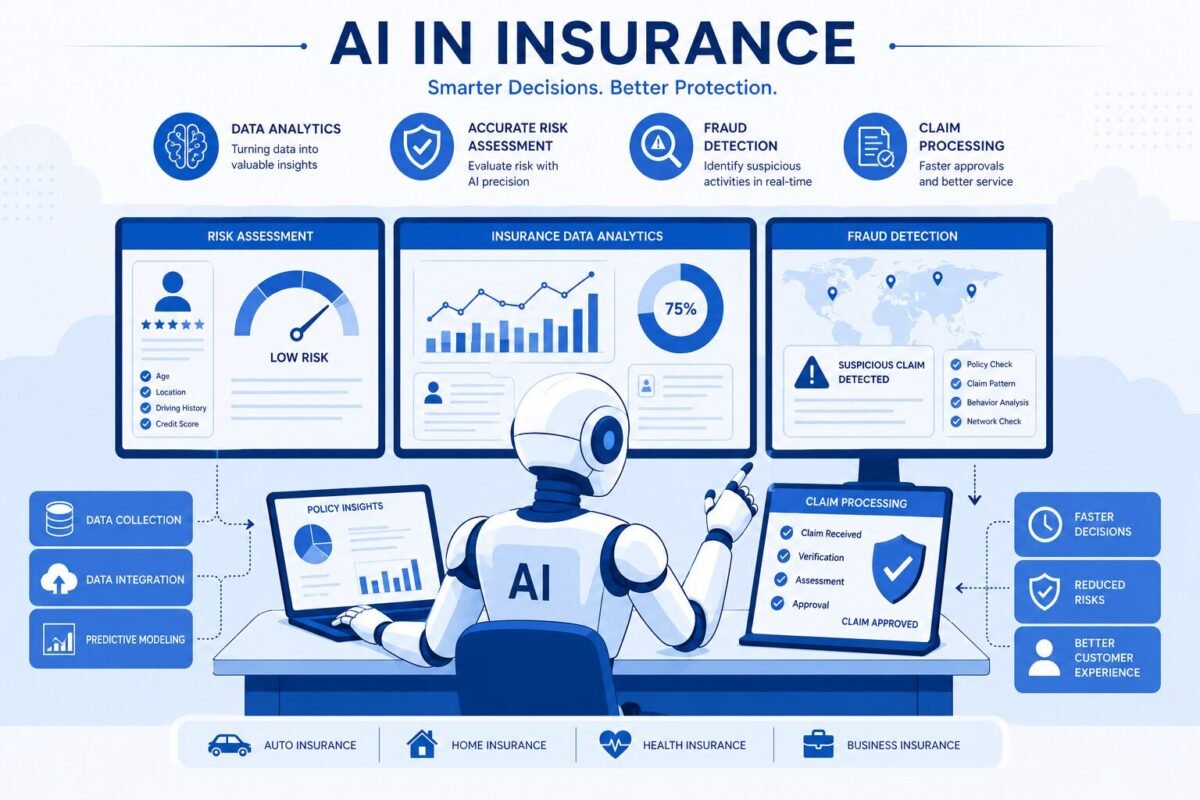
Claims processing is where insurance earns its reputation — or destroys it. AI-powered claims platforms remove the delays that frustrate policyholders and erode carrier margins simultaneously. A well-built AI claims system can receive a FNOL (First Notice of Loss), verify coverage, assess damage using computer vision, run fraud detection algorithms, and issue payment — all without a human in the loop for straightforward cases. If you want to see how AI makes claims faster in practice, the gap between a traditional carrier’s 14-day settlement timeline and an AI-driven startup’s 3-second settlement is almost impossible to overstate. Lemonade set the benchmark in 2017. That capability has now become the industry standard for digital-first players.
Real-World InsurTech Startups Leading With AI
Theory is one thing. The companies actually building and shipping AI in InsurTech at real scale are the story worth paying attention to. For a broader map of who’s competing in this space, the full guide to InsurTech startups lays out the entire ecosystem. But these specific companies show what separates genuine AI-first execution from marketing spin.
Lemonade, Tractable, and the AI-First Operators
Lemonade was the first consumer InsurTech to put AI at the center of its actual product — not as a feature bolted onto a traditional model, but as the operating engine of the entire company. Their AI, Maya, handles onboarding and policy questions. Their anti-fraud AI, Jim, cross-checks every claim against hundreds of behavioral and contextual signals before a single dollar is paid out. The result is a claims process that’s faster and, in many cases, more fraud-resistant than any traditional carrier can offer.
Tractable went business-to-business. Rather than selling directly to consumers, they built computer vision models that insurance carriers license to improve their own claims operations. Their systems have now processed tens of millions of damage assessments globally, making them one of the most data-rich AI companies in the property and casualty segment. Hippo Insurance collects data from connected smart home devices — leak sensors, smoke detectors, security systems — to underwrite homes more accurately and flag risks proactively before a claim ever gets filed. That’s the shift from reactive to preventive insurance. And it only works because of AI.
Real-World Scenarios: Success vs. Failure
Success — Lemonade’s 3-Second Claim Settlement: In January 2017, Lemonade’s AI settled a stolen Canada Goose jacket claim in 3 seconds. The AI received the claim, reviewed the policy, ran 18 anti-fraud checks, cross-referenced the FNOL details, approved the payment, and wired the money to the customer’s bank account — all without a human ever seeing the ticket. The customer waited 3 seconds. Not 3 days. Not 3 weeks. 3 seconds. This wasn’t a demonstration or a press stunt. It was production. The key lesson: When AI has access to clean, structured data and a well-defined process boundary, it consistently outperforms human workflows on both speed and accuracy. The business case for AI claims automation writes itself.
Failure — Algorithmic Bias in Auto Pricing Models: In 2021, a landmark investigation by ProPublica revealed that AI-driven auto insurance pricing models from several major US carriers were systematically charging higher premiums in predominantly Black and Hispanic neighborhoods — even after controlling for risk variables like claims history and vehicle type. The AI wasn’t intentionally discriminatory. It learned from decades of historical pricing data that already encoded systemic inequality. Regulators responded quickly. Several carriers faced mandatory model audits. Some were required to rebuild their underwriting systems from scratch. The key lesson: Deploying AI without structured bias testing and ongoing fairness monitoring isn’t just an ethical failure — it’s a regulatory and reputational exposure that can permanently damage a brand. Models trained on biased historical data will produce biased outputs. That’s not a hypothesis. It’s a documented outcome.
The Hidden Competitive Advantage: How AI Enables Hyper-Personalization at Scale
Here’s what most coverage of AI in InsurTech startups misses: the biggest competitive advantage isn’t cost reduction. It’s personalization. Traditional insurance has always been a product of averages. AI shatters that constraint entirely and creates a fundamentally different product experience in the process.
From Risk Segments to a Segment of One
Traditional actuarial models group policyholders into demographic buckets — age, location, claims history — and price the segment’s average risk. Everyone in the bucket pays roughly the same. AI models can effectively create a segment of one. They price each individual based on their specific driving record, the specific construction materials of their specific home, their specific behavioral patterns, and their specific constellation of risk signals. This isn’t just better pricing math — it’s a structurally better product.
Good drivers pay less. Careful homeowners pay less. Low-risk small businesses pay less. Customers who were subsidizing high-risk people in the same demographic bucket now get the price they actually deserve. That creates a powerful retention advantage: your best customers have far less incentive to shop around when they know they’re already getting a personalized price that reflects their actual risk profile.
Predictive Prevention as a Business Model Shift
The most advanced AI implementations in InsurTech don’t just react to risk — they predict and prevent it before it becomes a claim. Hippo’s smart home monitoring system alerts homeowners when a sensor detects water pressure anomalies that suggest a pipe is about to burst. Some health InsurTech companies use wearable data to flag early warning signs of chronic conditions and connect members with preventive care before a major medical event occurs. This model transforms insurance from a pure financial transfer mechanism into an active risk management service.
According to McKinsey, insurers that adopt AI-driven personalization and preventive engagement see customer retention rates improve by 20–30% compared to traditional static models. That’s not a marginal gain. That’s a structural business advantage that compounds every renewal cycle.
Regulatory Challenges and Ethical Considerations in AI-Driven Insurance
AI in InsurTech startups doesn’t operate outside the law. Regulators globally are watching the space closely — and in many markets, they’re actively intervening with new rules that have real teeth. Founders who treat compliance as an afterthought are building on sand.
Algorithmic Bias, Explainability, and the Regulator’s Growing Toolbox
The EU AI Act classifies AI systems used in insurance underwriting and claims as high-risk applications, which triggers strict requirements around bias testing, transparency documentation, and human oversight for consequential decisions. In the US, the National Association of Insurance Commissioners (NAIC) has published formal AI principles that encourage — and in several states explicitly require — explainable decision outputs when AI determines pricing or denies a claim. Regulators don’t just want accurate answers. They want to see the work. Black-box models are increasingly incompatible with regulated insurance markets.
The harsh reality found when reviewing model governance practices at several early-stage InsurTech firms is that most hadn’t built explainability into their AI systems from the start. It was bolted on as an afterthought when regulators came knocking — which is expensive, slow, and usually produces an incomplete audit trail. Build Explainable AI (XAI) architecture from day one. It’s not optional in insurance. It’s table stakes.
Data Privacy Laws and Regulatory Sandboxes
GDPR in Europe and CCPA in California impose strict constraints on how personal data can be collected, stored, and used in automated insurance decisions. This creates real friction for AI models that depend on rich behavioral and health data to generate accurate risk scores. InsurTech startups are addressing this through federated learning — training models on distributed data without centralizing raw personal information — and privacy-preserving techniques like differential privacy and synthetic data generation.
On the other side, regulatory sandboxes in the UK (run by the FCA), Singapore (MAS), and the UAE (ADGM) allow startups to test AI-powered insurance products in live markets under regulatory supervision before full licensing. These programs are specifically designed to let innovators move at startup speed without running into compliance walls that stop momentum cold. If you’re building in a new market, finding the local sandbox equivalent should be one of your first calls.
Industry Best Practices for InsurTech Startups Deploying AI
Building AI into an insurance product isn’t like adding a recommendation engine to an e-commerce app. The stakes are higher. The regulations are stricter. And when AI gets it wrong in insurance — biased pricing, wrongful claim denials, data breaches — real people get hurt and companies face existential consequences. Here’s what separates the InsurTechs that get AI right from the ones that become cautionary case studies.
Start Narrow, Scale Deep — Not the Other Way Around
The most common implementation mistake is trying to deploy AI across the entire business at once. The startups that build durable AI advantages pick one high-volume, high-pain-point process — usually claims intake, fraud detection, or underwriting for a specific product line — and build a genuinely excellent AI system for that specific problem. They run it in production with monitoring, human review for edge cases, and tight feedback loops. When it works reliably, they expand. Trying to AI-ify every process simultaneously almost always produces mediocre AI everywhere instead of exceptional AI somewhere useful.
Invest in data quality infrastructure before model sophistication. A powerful ML model trained on dirty, incomplete, or historically biased data will produce powerful wrong answers. The bottleneck at most early-stage InsurTech companies isn’t the algorithm — it’s the data pipeline. Clean, labeled, representative training data is the foundation everything sits on. Get that right first.
Build in Human Oversight and Mandatory Feedback Loops
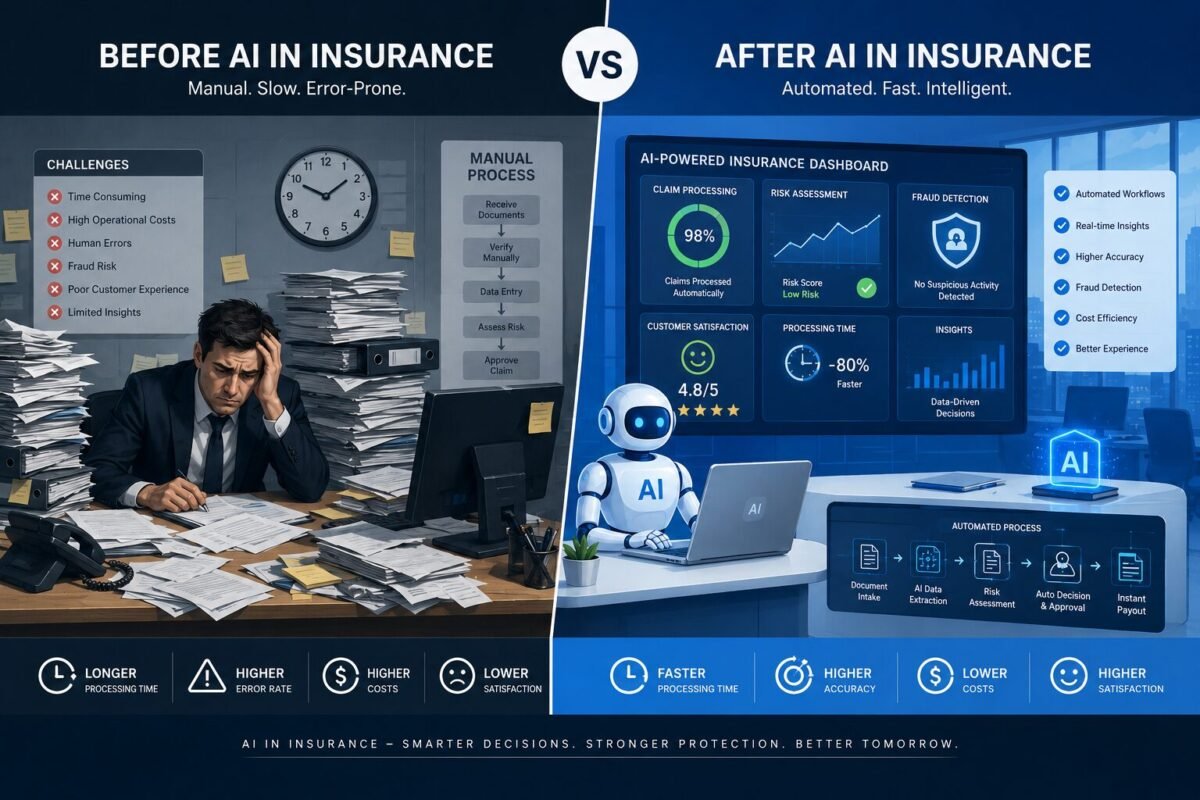
Fully automated AI decisions sound maximally efficient. And for commodity claims — a straightforward fender bender, a stolen laptop under a defined threshold — they can be. But complex claims, disputes, high-value policies, and edge cases require a human in the loop. Not because the AI can’t attempt the decision, but because regulators increasingly require explainable, accountable outcomes for consequential insurance decisions. Build AI to handle volume and flag complexity — not to replace human judgment entirely for every scenario. Establish structured feedback mechanisms where human reviewers correct AI errors, and route those corrections back into model retraining cycles. That feedback loop is how AI systems in insurance actually get better in production over time.
What the Future of AI in InsurTech Looks Like
Where does this all go from here? The trajectory is clear, even if the exact timeline isn’t. AI in InsurTech startups is moving from automation to intelligence — from doing known things faster to making entirely new business models possible that didn’t exist before.
Generative AI, Embedded Insurance, and the API-First Model
Generative AI is already showing up inside InsurTech workflows in ways that weren’t feasible two years ago. Large language models can draft policy wording, generate claims summaries from adjuster notes, answer complex coverage questions in plain language, and simulate risk scenarios for commercial underwriters. The administrative cost impact alone could be transformative for carriers running policy administration on legacy systems. Embedded insurance — where coverage is sold inside a third-party experience at the moment of purchase (travel insurance during flight booking, device protection during laptop checkout) — is now running almost entirely on AI APIs. The end-state is insurance as invisible infrastructure: coverage that appears exactly when relevant and disappears when it’s not, powered entirely by real-time AI decisions.
The IoT-AI Convergence and Real-Time Risk Pricing
The longer horizon is a real-time risk ecosystem where connected devices, AI models, and insurance policies update continuously based on live data. Your home insurance premium shifts based on air quality readings, wildfire proximity scores, and the status of your smart security system. Your health coverage responds to wearable data inputs in real time. Your commercial property policy adjusts dynamically based on occupancy sensors and equipment telemetry from the factory floor. Pilots of these systems are already running in several markets. Within five years, real-time IoT-driven AI insurance will move from experimental to expected for early adopters across health, home, auto, and commercial lines.
Frequently Asked Questions
How is AI different from traditional automation in insurance companies?
Traditional automation in insurance is rule-based. It follows fixed decision logic: if X, then Y. If a claim meets a specific set of criteria, route it this way. If it doesn’t, escalate to a human. These systems are predictable but rigid — they can’t adapt to situations they weren’t explicitly programmed to handle, and they can’t improve over time without a developer manually rewriting the rules. AI — particularly machine learning — operates on an entirely different principle. Instead of following pre-written instructions, ML models build their own decision logic from patterns in historical outcomes. A rule-based system stays exactly as accurate as the day it was built. A machine learning model gets more accurate every time it processes new labeled data. That self-improving capability is what makes AI in InsurTech startups genuinely transformative, not just a faster version of the same underlying process. The gap between the two approaches widens over time as the AI model compounds on each iteration.
Can small InsurTech startups afford to implement AI solutions?
Yes — and the cost of entry has dropped significantly over the past three years. Pre-trained foundation models from providers like OpenAI, Google, Anthropic, and Hugging Face cover a wide range of NLP and computer vision tasks without requiring startups to train models from scratch on proprietary hardware. Cloud AI platforms from AWS (SageMaker), Google Cloud (Vertex AI), and Microsoft Azure offer consumption-based pricing that scales with your actual usage rather than requiring massive upfront infrastructure investment. Low-code ML tools allow small technical teams to build, test, and deploy models without a full data science department. The real cost for early-stage InsurTechs isn’t the AI technology itself — it’s the data. Acquiring clean, labeled, insurance-specific training data is where the actual investment lives. Partnerships with incumbent carriers, MGA data-sharing agreements, synthetic data generation, and regulatory sandbox participation are all viable paths for startups that don’t yet have years of proprietary claims history to train on.
Is AI in insurance making human agents and underwriters obsolete?
Not in any realistic near-term scenario — but it’s absolutely changing what those roles look like and how many of them are needed. AI is eliminating specific high-volume, repetitive tasks. Routine claims triage, basic policy Q&A, document extraction, fraud signal detection, and renewal reminders are all moving away from human queues. But complex commercial underwriting, relationship-driven insurance brokerage, high-value claims that involve negotiation and empathy, coverage disputes, and regulatory compliance work all still require trained human expertise and judgment. What’s genuinely changing is the ratio. Ten skilled underwriters equipped with AI tools can now handle the volume that once required fifty. That’s not obsolescence — it’s augmentation. The professionals who will thrive in AI-driven insurance are the ones who know how to interpret model outputs, override when the model is wrong, and focus their expertise on the decisions that AI genuinely can’t make well on its own.
What are the biggest risks of relying on AI for insurance decisions?
There are three risks that should be at the top of every InsurTech leader’s agenda. First, algorithmic bias: AI models trained on historical insurance data inherit the biases embedded in that data. If past pricing systematically disadvantaged certain zip codes, ethnic groups, or demographics, the model will reproduce those patterns at scale — and faster than any human underwriter could. Bias auditing and fairness testing aren’t optional extras. They’re non-negotiable requirements. Second, model drift: an AI model trained on pre-pandemic driving patterns will produce increasingly inaccurate auto risk scores in a world where remote work has fundamentally changed how and when people drive. Models need continuous monitoring, performance tracking, and scheduled retraining to stay calibrated to current real-world behavior. Third, regulatory exposure: an AI underwriting or claims decision that a regulator classifies as unexplainable, discriminatory, or non-compliant with local insurance laws can result in substantial fines, mandatory model audits, product suspensions, and forced market exit. AI in InsurTech startups that skip governance infrastructure aren’t just accepting technical risk — they’re accepting existential business risk that can materialize faster than most founders expect.
The Bottom Line
AI in InsurTech startups isn’t a future possibility or a venture capital talking point — it’s the current competitive baseline across every major line of personal and commercial insurance. The companies winning right now aren’t the ones with the slickest mobile interfaces or the catchiest brand names. They’re the ones that have built AI systems that underwrite more accurately, settle claims faster, detect fraud more reliably, and personalize coverage more precisely than any traditional competitor can replicate with legacy infrastructure and manual processes.
The shift is real. It’s accelerating. And it isn’t reversible. Whether you’re a founder building in this space, an investor evaluating it, or simply a policyholder who deserves better than a 14-day claims process — understanding how AI is reshaping insurance isn’t optional knowledge anymore. It’s the price of being informed in 2025 and beyond.






Leave a Reply